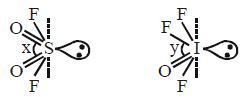
MCQ
The molecule has $sp^3d^2$, hybridisation and square planar shape
- A$SF_4$
- B$BF_4^-$
- ✓$ICl_4^-$
- D$XeO_2F_2$
| Chemical species | Hybridisation of central atom |
| $ICl _2^{-}$ | $sp ^3 d$ |
| $IF _6^{-}$ | $sp ^3 d ^3$ |
| $ICl _4^{-}$ | $sp ^3 d ^2$ |
| $BrF _2^{-}$ | $sp ^3 d$ |
Generate a complete, print-ready paper with questions like this in minutes — across 16+ boards, with answer keys.
$CaC{O_3}\left( s \right)\overset \Delta \longleftrightarrow CaO\left( s \right) + C{O_2} \uparrow ,{K_p} = 8 \times {10^{ - 2}}$
$C{O_2}\left( g \right) + C\left( s \right) \rightleftharpoons 2CO\left( g \right),{K_p} = 2$
$A + B \rightleftharpoons C + D$ is $1 \times 10^{-2}$ at $298\, K$ and is
$2$ at $273\, K$. The chemical process resulting in the formation of $C$ and $D$ is
$(I)\,[Kr]\,5s^1$ $(II)\, [Rn]\,5f^{14}\,6d^1\,7s^2$
$(III)\,[Ar]\,3d^{10}\,4s^2\,4p^5$ $(IV)\,[Ar]\,3d^6\,4s^2$
Consider the following Statements
$(i)\, I$ shows variable oxidation State
$(ii)\, II$ is a $d-block$ element
$(iii)$ The compound formed between $I$ and $III$ is covalent
$(iv)\,IV$ shows single oxidation state
Which Statement is True $(T)$ or False $(F)$?