MCQ
The molecules represented by the above two structures are
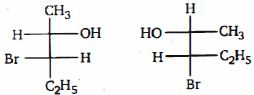
  • identical
  • B
    enantiomers
  • C
    diastereomers
  • D
    epimers

Answer

Correct option: A.
identical
a
$(a)$ Both molecule have same configuration so are identical

Need a full question paper?

Generate a complete, print-ready paper with questions like this in minutes — across 16+ boards, with answer keys.

Start Generating Free

Similar questions

The $IUPAC$ name of the following compound is

$\begin{array}{*{20}{c}}
  {^{C{H_3}}} \\ 
  {_H} 
\end{array}\begin{array}{*{20}{c}}
  {{\text{ }}\backslash {\text{ }}} \\ 
  / 
\end{array}\mathop C\limits^{} {\mkern 1mu}  = \mathop C\limits^{} {\mkern 1mu} \begin{array}{*{20}{c}}
  / \\ 
  {{\text{ }}\backslash {\text{ }}} 
\end{array}_{\mathop C\limits^{} {\kern 1pt}  \equiv \mathop C\limits^{} {\kern 1pt}  - \mathop C\limits^{} {\kern 1pt} {H_2}\mathop C\limits^{} {\kern 1pt} {H_3}}^H{\mkern 1mu} $

If the $Z{n^{2 + }}/Zn$ electrode is diluted to $100$ times then the change in e.m.f.
Most stable conformation of  $n-$ butane is
The bond enthalpies of $H_2, X_2$ and $HX$ are in the ratio of $2 : 1 : 2.$ If the standard enthalpy for formation of $HX$ is $-50\, kJ \,mol^{-1} ,$ the bond enthalpy of $H_2$ is....$kJ\, mol^{-1}$
Consider the following statements :

In the chemical reaction

$Mn{O_2} + 4HCl \to MnC{l_2} + 2{H_2}O + C{l_2}$

$(1)$ Manganese ion is oxidised

$(2)$ Manganese ion is reduced

$(3)$ Chloride ion is oxidised

$(4)$Chloride ion is reduced.

Which of these statements are correct

Which of the following product will be obtained in the given (consider minor  product also) Beckman $n-$ type rearrangement ?
Which of the following order is CORRECT
The radius of the nucleus is related to the mass number $A$ by
Which $L$ -sugar on oxidation gives an optically active dibasic acid
Given that bond energies of $H - H$ and $Cl - Cl$ are $430\ kJ\ mol^{-1}$ and $240\ kJ\ mol^{-1}$ respectively and $\Delta H_f$ for $HCl$ is $-90\ kJ\ mol^{-1},$ bond enthalpy of $HCl$ is ............... $\mathrm{kJ \,mol}^{-1}$