MCQ
The most strained cycloalkane is
  • Cyclopropane
  • B
    Cyclobutane
  • C
    Cyclopentane
  • D
    Cyclohexane

Answer

Correct option: A.
Cyclopropane
a
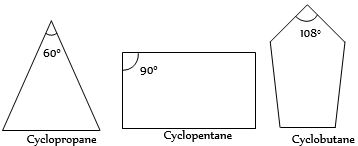
(a) Cyclopropane with a bond angle of ${60^o}$ is very strained and hence very reactive.

Need a full question paper?

Generate a complete, print-ready paper with questions like this in minutes — across 16+ boards, with answer keys.
Start Generating Free

Similar questions

The gas phase reaction $2NO_2(g) \rightleftharpoons   N_2O_4 (g)$ is an exothermic reaction. The decomposition of $N_2O_4,$ in equilibrium mixutre of  $NO_2(g)$  and $N_2O_4(g),$ can be increased by
Which one is used as a bye-product in Serpeck's process
The ionization enthalpy of $Na ^{+}$ formation from $Na _{( g )}$ is $495.8\, kJ\, mol ^{-1},$ while the electron gain enthalpy of $Br$ is $-325.0\, kJ\, mol ^{-1}$. Given the lattice enthalpy of $NaBr$ is $-728.4\, kJ\, mol ^{-1}$. The energy for the formation of NaBr ionic solid is $(-)$ ........... $\times 10^{-1} kJ \,mol ^{-1}$
A sample of $4.5\,mg$ of an unknown monohydric alcohol, $R - OH$ was added to methylmagnesium iodide. A gas is evolved and is collected and its volume measured to be $3.1\,mL$. The molecular weight of the unknown alcohol is $g / mol$. [Nearest integer]
Amongst the following species, maximum covalent character is exhibited by
Formula of the following silicate anion structure is, where $ \bullet $ $ -'Si'$ atom,  $o-'O'$ atom
The empirical formula of a compound is CH2. One mole of this compound has a mass of 42g. Its molecular formula is a:
The internal energy change when a system goes from state $A$ to $B$ is $40 \,\,kJ/mole$. If the system goes from $A$ to $B$ by a reversible path and returns to state $A$ by an irreversible path what would be the net change in internal energy
Assertion : All $F—S—F$ angle in $SF_4$ are greater than $90^o$ but less than $180^o$,
Reason : The lone pair- bond pair repulsion is weaker than bond pair-bond pair repulsion.
In some solutions, the concentration of $H_3O^+$ remains constant even when small amounts of strong acid or strong base are added to them. These solutions are known as