MCQ
The most volatile compound is
  • $2, 2-$ dimethyl propane
  • B
    $2-$ methyl butane
  • C
    Isobutane
  • D
    $n-$ pentane

Answer

Correct option: A.
$2, 2-$ dimethyl propane
a
The boiling point is inversely proportional to the branch in the compound. Therefore, $2,2$-dimethyl propane has more branching, higher boiling point.

Need a full question paper?

Generate a complete, print-ready paper with questions like this in minutes — across 16+ boards, with answer keys.

Start Generating Free

Similar questions

Which of the following has highest heat of hydrogenation.
In the periodic table first transition series is placed in
The group of hetrocylic compounds is:
The conductance of a $0.0015 \mathrm{M}$ aqueous solution of a weak monobasic acid was determined by using a conductivity cell consisting of platinized $\mathrm{Pt}$ electrodes. The distance between the electrodes is $120 \mathrm{~cm}$ with an area of cross section of $1 \mathrm{~cm}^2$. The conductance of this solution was found to be $5 \times 10^{-7} \mathrm{~S}$. The $\mathrm{pH}$ of the solution is $4$ . The value of limiting molar conductivity $\left(\Lambda_{\mathrm{m}}^0\right)$ of this weak monobasic acid in aqueous solution is $\mathrm{Z} \times 10^2 \mathrm{~S} \mathrm{~cm}^{-1} \mathrm{~mol}^{-1}$. The value of $\mathrm{Z}$ is
Which has the highest second ionisation potential
Which represents an alkane
Match $List-I$ with $List-II$. 

$List-I$ $List-II$
$(A)$ $Cd ( s )+2 Ni ( OH )_{3}( s ) \rightarrow CdO ( s )+2 Ni ( OH )_{2}( s )+ H _{2} O (l)$ $(I)$ Primary battery
$(B)$  $Zn ( Hg )+ HgO ( s ) \rightarrow ZnO ( s )+ Hg (l)$ $(II)$ Discharging of secondary battery
$(C)$ $2 PbSO _{4}( s )+2 H _{2} O (l) \rightarrow Pb ( s )+ PbO _{2}( s )+ 2 H _{2} SO _{4}( aq )$ $(III)$ Fuel cell 
$(D)$ $2 H _{2}( g )+ O _{2}( g ) \quad \rightarrow 2 H _{2} O (l)$ $(IV)$ Charging of secondary battery

Choose the correct answer from the options given below.

The major product ' $P$ ' formed in the given reaction is
The standard electrode potential $({E^o})$ for $OC{l^ - }/C{l^ - }$ and $C{l^ - }/\frac{1}{2}C{l_2}$ respectively are $0.94\,V$ and $ - 1.36\,V$. The ${E^o}$ value for $OC{l^ - }/\frac{1}{2}C{l_2}$ will be ............... $\mathrm{V}$
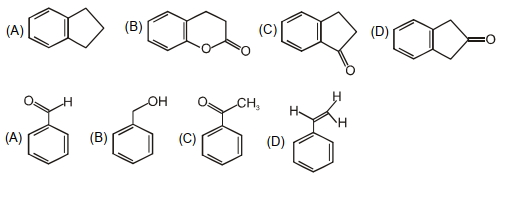
In the following reactions sequence, the compound $J$ is an intermediate.
$I \frac{\left(CH_3 CO\right)_2 O}{CH_3 COONa} J \xrightarrow[\text { (ii) } SOCl]{\text { (i) } H_2, Pd / C} K$
$(ii)$ anhyd. $AlCl _3$
$J \left( C _9 H _8 O _2\right)$ gives effervescence on treatment with $NaHCO _3$ and positive Baeyer's test
$1.$ The compound $K$ is
mcq $Image$
$2.$ The compound $I$ is
mcq $Image$
Give the answer question $1$ and $2.$