Question
The motion of a particle executing simple harmonic motion is described by the displacement function,$\text{x(t)}=\text{A}\cos(\omega\text{t}+\phi).$
If the initial (t = 0) position of the particle is 1cm and its initial velocity is $\omega\text{ cm/s,}$ what are its amplitude and initial phase angle? The angular frequency of the particle is $\pi\text{s}^{-1}.$ If instead of the cosine function, we choose the sine function to describe the SHM: $\text{x}=\text{B}\sin(\omega\text{t}+\alpha),$ what are the amplitude and initial phase of the particle with the above initial conditions.
Answer

Initially, at t = 0: Displacement, x = 1cm Initial velocity, $\text{v}=\omega\text{ cm/sec.}$ Angular frequency, $\omega=\pi\text{ rad/s}^{-1}$ It is given that: $\text{x(t)}=\text{A}\cos(\omega\text{t}+\phi)$ $1=\text{A}\cos(\omega\times0\times\phi)$ $\text{A}\cos\phi=1\ ........(1)$ $\text{Velocity, }\upsilon=\frac{\text{dx}}{\text{dt}}$ $\omega=-\text{A}\omega\sin(\omega\text{t}+\phi)$ $1=-\text{A}\sin(\omega\times0+\phi)=-\text{A}\sin\phi$ $\text{A}\sin\phi=-1\ ....(2)$ Squaring and adding equations (1) and (2), we get: $\text{A}^2(\sin^2\phi+\cos^2\phi)=1+1$ $\text{A}^2=2$ $\therefore\ \text{A}=\sqrt{2}\ \text{cm}$ Dividing equation (2) by equation (1), we get: $\tan\phi=-1$ $\therefore\ \phi=\frac{3\pi}{4},\frac{7\pi}{4},....$ SHM is given as: $\text{x}=\text{B}\sin(\omega\text{t}+\alpha)$Putting the given values in this equation, we get:
$1=\text{B}\sin[\omega\times0+\alpha]$ $\text{B}\sin\alpha=1\ .....(3)$ Velocity, $\upsilon=\omega\text{B}\cos(\omega\text{t}+\alpha)$ Substituting the given values, we get: $\pi=\pi\text{B}\sin\alpha$ $\text{B}\sin\alpha=1\ .....(4)$ Squaring and adding equations (3) and (4), we get:$\text{B}^2[\sin^2\alpha+\cos^2\alpha]=1+1$
$\text{B}^2=2$
$\therefore\ \text{B}=\sqrt{2}\text{ cm}$
Dividing equation (3) by equation (4), we get: $\frac{\text{B}\sin\alpha}{\text{B}\cos\alpha}=\frac{1}{1}$ $\tan\alpha=1=\frac{\tan\alpha}{4}$ $\therefore\ \alpha=\frac{\pi}{4},\frac{5\pi}{4}, .....$

Need a full question paper?

Generate a complete, print-ready paper with questions like this in minutes — across 16+ boards, with answer keys.

Start Generating Free

Similar questions

A fighter plane is flying horizontally at an altitude of 1.5km with speed 720km/ h. At what angle of sight (w.r.t. horizontal) when the target is seen, should the pilot drop the bomb in order to attack the target?
An air-filled parallel-plate capacitor is to be constructed which can store $12\mu\text{C}$ of charge when operated at $1200V$. What can be the minimum plate area of the capacitor? The dielectric strength of air is $3 \times 10^6Vm^{-1}$.
Explain sound waves and write their properties.
Derive the equations of an object moving with uniform acceleration by graphical method
A block slides down an inclined surface of inclination 30° with the horizontal. Starting from rest it covers 8m in the first two seconds. Find the coefficient of kinetic friction between the two.
A current of 1.0A is established in a tightly wound solenoid of radius 2cm having 1000 turns/ metre. Find the magnetic energy stored in each metre of the solenoid.
Is it possibe for a body to have inertia but no weight?
  1. Derive an expression for the excess pressure inside a soap bubble.
  2. State Bernoulli's theorem.
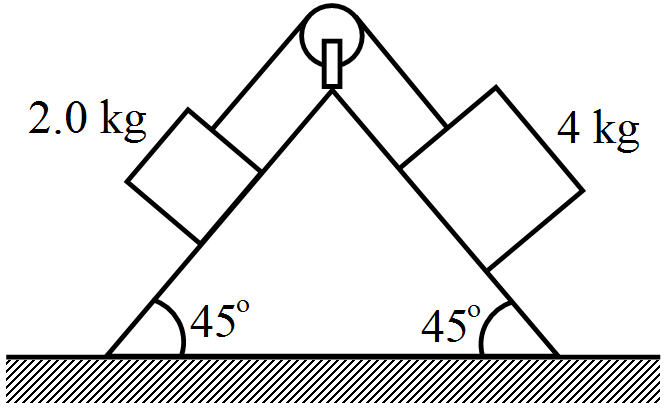
The pulley shown in figure has a radius $10cm$ and moment of inertia $0.5kg-m^2$ about its axis. Assuming the inclined planes to be frictionless, calculate the acceleration of the $4.0kg$ block.
State, for each of the following physical quantities, if it is a scalar or a vector : volume, mass, speed, acceleration, density, number of moles, velocity, angular frequency, displacement, angular velocity.