MCQ
The motion of a torsional pendulum is:
  • A
    Periodic.
  • B
    Oscillatory.
  • C
    Angular simple harmonic.
  • All of the above

Answer

Correct option: D.
All of the above
Because it completes one oscillation in a fixed interval of time and the oscillations are in terms of rotation of the body through some angle.

Need a full question paper?

Generate a complete, print-ready paper with questions like this in minutes — across 16+ boards, with answer keys.

Start Generating Free

Similar questions

The water equivalent of $20 \,g$ of aluminium (specific heat $0.2 \,cal ^{-1}{ }^{\circ} C ^{-1}$ ), is ......... $g$
An aeroplane flying at a constant velocity releases a bomb.As the bomb drops down from the aeroplane,
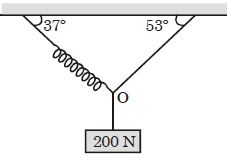
In the setup shown, a $200\, N$ block is supported in equilibrium with the help of strings  and a spring. A point $O$, the strings knotted. Extension in the spring is $4\, cm$. Force   constant of the spring is closest to ............ $N/m$ $[g = 10\, m/s^2]$
Work done by a sample of an ideal gas in a process $A$ is double the work done in another process $B.$ The temperature rises through the same amount in the two processes. If $C_A$ and $C_B$ be the molar heat capacities for the two processes:
A piece of ice slides down a rough inclined plane at $\theta=45^{\circ}$ inclination in twice the time that it takes to slide down an identical but frictionless inclined plane. What is the coefficient of friction between ice and incline ?
A body executes simple harmonic motion under the action of a force $F_1$ with a time period $(4/5)\, sec$. If the force is changed to $F_2$ it executes $SHM$ with time period $(3/5)\, sec$. If both the forces $F_1$ and $F_2$ act simultaneously in the same direction on the body, its time period (in $seconds$ ) is
A simple pendulum has time period $T_1$. The point of suspension is now moved upwards according to relation, $y=kt^2. (k = 1ms^{-2}),$ where $y$ is the vertical displacement. The time period now becomes $T_2$. The ratio of $\frac{\text{T}^2_1}{\text{T}^2_2}$ is $(g = 10\ ms^2)$
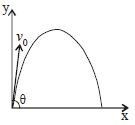
A small particle of mass $m$ is projected at an angle $\theta $ with the $x-$ axis with an initial velocity $v_0$ in the $x-y$ plane as shown in the figure. At a time $t < \frac{{{v_0}\,\sin \,\theta }}{g}$, the angular momentum of the particle is
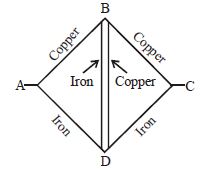
Six wire each of cross-sectional area $A$ and length $l$ are combined as shown in the  figure. The thermal conductivities of copper and iron are $K_1$ and $K_2$ respectively.  The equivalent thermal resistance between points $A$ and $C$ is :-
When water is heated from $0$ to $4\,^oC$