MCQ
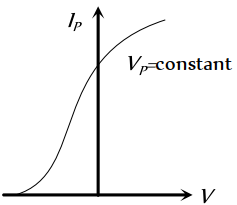
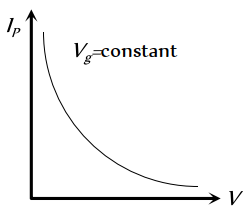
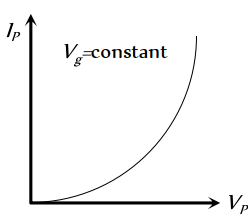
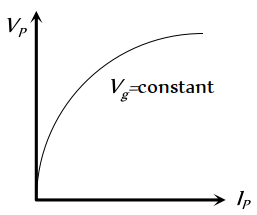
The mutual characteristic of triode is
  • A
    Image
  • B
    Image
  • Image
  • D
    Image

Answer

Correct option: C.
Image
This is the graph between $i$ and $V$ and $i$, becomes zero at certain negative potential.

Need a full question paper?

Generate a complete, print-ready paper with questions like this in minutes — across 16+ boards, with answer keys.
Start Generating Free

Similar questions

A Young's double slit experiment uses a monochromatic source. The shape of the interference fringes formed on a screen is
A cube of aluminium of sides $0.1 m$ is subjected to a shearing force of $100 N$. The top face of the cube is displaced through $0.02 cm$ with respect to the bottom face. The shearing strain would be
A system performs work $\Delta W$ when an amount of heat is $\Delta Q$ added to the system, the corresponding change in the internal energy is $\Delta U$. A unique function of the initial and final states (irrespective of the mode of change) is
The velocity of a body moving with a uniform acceleration of $2 m . / sec ^2$ is $10 m / sec$. Its velocity after an interval of $4 sec$ is
A body of mass $2 \mathrm{~kg}$ is thrown up vertically with K.E. of $490$ joules. If the acceleration due to gravity is $9.8 \mathrm{~m} / \mathrm{s}^2$, then the height at which the K.E. of the body becomes half its original value is given by
An engine is supposed to operate between two reservoirs at temperature $727^{\circ} \mathrm{C}$ and $227^{\circ} \mathrm{C}$. The maximum possible efficiency of such an engine is
If $2.2 kW$ power is transmitted through a $100 \Omega$ line at $22,000 V$, the power loss in the form of heat will be
The distance of neptune and saturn from sun are nearly $10^{13}$ and $10^{12}$ meters respectively. Assuming that they move in circular orbits, their periodic times will be in the ratio
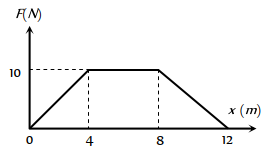
A particle of mass $0.1 \mathrm{~kg}$ is subjected to a force which varies with distance as shown in fig. If it starts its journey from rest at $x=0$, its velocity at $x=12 \mathrm{~m}$ isImage
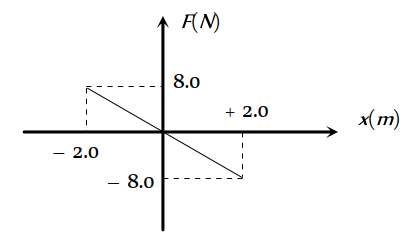
A body of mass $0.01 kg$ executes simple harmonic motion (S.H.M.) about $x=0$ under the influence of a force shown below: The period of the S.H.M. is

Image