MCQ
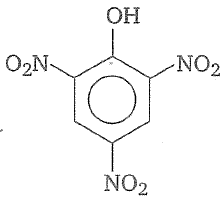
The nature of $2, 4, 6-$trinitrophenol is:
- ANeutral
- BBasic
- ✓Acidic
- DWeak basic
Generate a complete, print-ready paper with questions like this in minutes — across 16+ boards, with answer keys.
$C{H_3}COOH + PC{l_5} \to A\mathop {\xrightarrow{{{C_6}{H_6}}}}\limits_{anh.\,AlC{l_3}} $ $B\mathop {\xrightarrow{{{C_2}{H_5}MgBr}}}\limits_{ether} C$
$2 \mathrm{H}_{2}(\mathrm{g})+2 \mathrm{NO}(\mathrm{g}) \rightarrow \mathrm{N}_{2}(\mathrm{g})+2 \mathrm{H}_{2} \mathrm{O}(\mathrm{g})$
the observed rate expression is, rate $=\mathrm{k}_{\mathrm{f}}[\mathrm{NO}]^{2}\left[\mathrm{H}_{2}\right] .$ The rate expression of the reverse reaction is
$(1)$ Oxidation of glucose with bromine water gives glutamic acid
$(2)$ The two six-membered cyclic hemiacetal forms of $D-(+)$-glucose ard called anomers
$(3)$ Hydrolysis of sucrose gives dextrorotatory glucose and laevorotatory fructose
$(4)$ Monosaccharides cannot be hydrolysed to give polyhydroxy aldehydes and ketones