MCQ
The nature of effective nuclear forces is :
  • A
    Strong electrical repulsion
  • B
    Strong electric attraction
  • Strong force of attraction
  • D
    Like Van der Waals forces

Answer

Correct option: C.
Strong force of attraction

Need a full question paper?

Generate a complete, print-ready paper with questions like this in minutes — across 16+ boards, with answer keys.

Start Generating Free

Similar questions

In hydrogen spectrum the wavelength of $H _\alpha$ line is 656 nm whereas in the spectrum of a distant galaxy, $H _\alpha$ line wavelength is 706 nm . Estimated speed of the galaxy with respect to earth is
Let $n_r$ and $n_b$ be the number of photons emitted by a red bulb and a blue bulb, respectively, of equal power in a given time:
Assertion : The positive charge particle is placed in front of a spherical uncharged conductor. The number of lines of forces terminating on the sphere will be more than those emerging from it.

Reason : The surface charge density at a point on the sphere nearest to the point charge will be negative and maximum in magnitude compared to other points on the sphere
The speed of light depends:
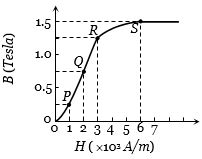
The basic magnetization curve for a ferromagnetic material is shown in figure. Then, the value of relative permeability is highest for the point
A ray of light incidents on a plane mirror at an angle of 30°. The deviation produced in the ray is
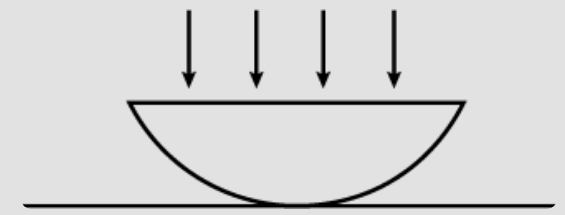
A thin slice is cut out of a glass cylinder along a plane parallel to its axis. The slice is placed on a flat glass plae as shown in figure. The observed interference fringes from this combination shall be:
Monochromatic green light of wavelength $5 \times 10^{-7} m$ illuminates a pair of slits 1 mm apart. The separation of bright lines on the interference pattern formed on a screen 2 m away is
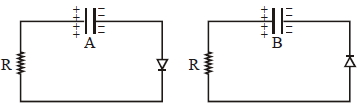
Two identical capacitors $\mathrm{A}$ and $\mathrm{B}$, charged to the same potential $5\; \mathrm{V}$ are connected in two different circuits as shown below at time $\mathrm{t}=0$ If the charge on capacitors $A$ and $B$ at time $\mathrm{t}=\mathrm{CR}$ is $\mathrm{Q}_{\mathrm{A}}$ and $\mathrm{Q}_{\mathrm{B}}$ respectively, then (Here $e$ is the base of natural logarithm)
A magnetic needle is made to vibrate in uniform field H, then its time period is T. If it vibrates in the field of intensity 4H, its time period will be