MCQ
The net applied force on a body in uniform circular motion should always be
  • A
    Constant in magnitude and parallel to direction of motion
  • Constant in magnitude and perpendicular to direction of motion
  • C
    Gravitational in nature
  • D
    Zero

Answer

Correct option: B.
Constant in magnitude and perpendicular to direction of motion
b

Need a full question paper?

Generate a complete, print-ready paper with questions like this in minutes — across 16+ boards, with answer keys.
Start Generating Free

Similar questions

$Assertion$ : Centripetal and centrifugal forces cancel each other.
$Reason$ : Centrifugal force is a reaction of centripetal force
A small mass $'m'$ rests at the edge of a horizontal disc of radius $'R'$ . The coefficient of static friction between mass and the disc is $\mu $ . The disc is rotated about its axis at an angular velocity such that the mass slides off the disc and lands on the floor $'h'$ meters below. What was its horizontal distance of travel from the point it left the disc?
A pendulum bob has a speed of $3\, m/s$ at its lowest position. The pendulum is $0.5\, m$ long. The speed of the bob, when the length makes an angle of ${60^o}$ to the vertical, will be ..... $m/s$ (If $g = 10\,m/{s^2}$)
The displacement of a particle executing periodic motion is given by :
$y = 4cos^2\,(t/2)sin\,(1000t)$
This expression may be considered to be a result of superposition of
Gravitational mass is proportional to gravitational
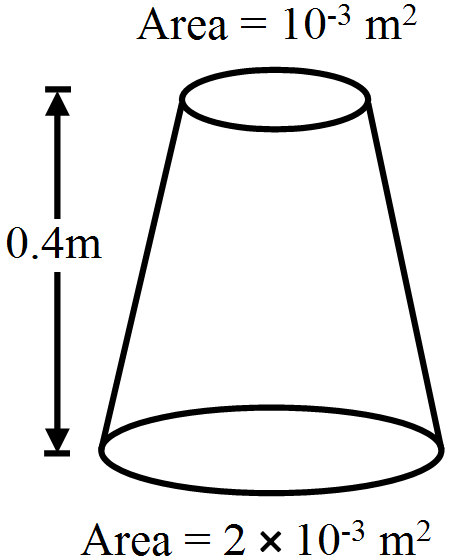
A uniformly tapering vessel is filled with a liquid of density 900k gm-3. The force that acts on the base of the vessel due to the liquid is (Take, g = 10 ms-2)

One thousand small water drops of equal radii combine to form a big drop. The ratio of final surface energy to the total initial surface energy is
The length and breadth of a metal sheet are 3.124m and 3.002m respectively. The area of this sheet up to four correct significant figures is:
If two liquids of same volume but different densities $\rho_1$ and $\rho_2$ are mixed, then density of mixture is given by:
A particle moves so that its position vector is given by $\overrightarrow {\;r} = cos\omega t\,\hat x + sin\omega t\,\hat y$ , where $\omega$ is a constant.  Which of the following is true?