MCQ
The noble gases can be separated by
  • A
    passing them through suitable solution
  • B
    electrolysis of their fluorides
  • adsorption and desorption on charcoal
  • D
    adsorption and desorption on activated hydrogen

Answer

Correct option: C.
adsorption and desorption on charcoal
c
The gaseous mixture that is free of oxygen and nitrogen is used for separating the noble gases. This is done using coconut charcoal which adsorbs different gases at different temperatures.

The property of adsorption to coconut charcoal increases with atomic weight of the noble gases. Thus, helium which has the least atomic weight adsorbs the least while xenon with maximum atomic weight adsorbs strongly.

The temperature at which the adsorption takes place increases with the increase in the atomic weight.

Need a full question paper?

Generate a complete, print-ready paper with questions like this in minutes — across 16+ boards, with answer keys.

Start Generating Free

Similar questions

Two solutions $A$ and $B$, each of $100\; L$ was made by dissolving $4 \;\mathrm{g}$ of $\mathrm{NaOH}$ and $9.8 \;\mathrm{g}$ of $\mathrm{H}_{2} \mathrm{SO}_{4}$ in water, respectively. The $\mathrm{pH}$ of the resultant solution obtained from mixing $40\; \mathrm{L}$ of solution $A$ and $10\; \mathrm{L}$ of solution $\mathrm{B}$ is
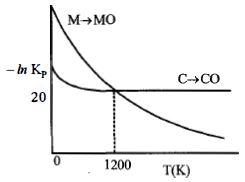
The plot shows the variation of $- In\,K_p$ versus temperature for the two reactions.

$M(s) + \frac{1}{2}{O_2}(s)\, \to \,MO(s)\,$  and  $C(s) + \frac{1}{2}{O_2}(g)\, \to \,CO(s)\,$

Identify the correct statement
$BF_3$ and $NF_3$ both are covalent compounds but $NF_3$ is polar whereas  $BF_3$ is non-polar. This is because
In a chemical reaction $A + 2B \overset K  \rightleftharpoons  2C + D$, the initial concentration of $B$ was $1.5$ times of $A$ but the equilibrium concentrations of $A$ and $B$ were found to be equal. The equilibrium, constant $(K)$ for the aforesaid chemical reaction is
Approximate atomic weight of an element is $26.89$. If its equivalent weight is $8.9$, the exact atomic weight of element would be
How many ions are produced in aqueous solution of $[Co{({H_2}O)_6}]\,C{l_2}$
Which of following reaction sequence shows overall inversion of configuration in product ?
A gas decolourised $KMn{O_4}$ solution but gives no precipitate with ammoniacal cuprous chloride is or Which of the following gases does not give a precipitate with ammoniacal solution of silver nitrate but decolourizes $KMn{O_4}$ (neutral or slightly alkaline)
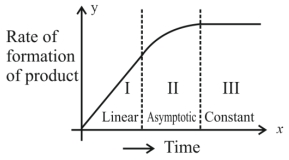
For certain chemical reaction $X \rightarrow Y$, the rate of formation of product is plotted against the time as shown in the figure. The number of Correct statement/s from the following is $.......$.

$(A)$ Over all order of this reaction is one

$(B)$ Order of this reaction can't be determined

$(C)$ In region$-I$ and $III$, the reaction is of first and zero order respectively

$(D)$ In region$-II$, the reaction is of first order

$(E)$ In region$-II$, the order of reaction is in the range of $0.1$ to $0.9$.
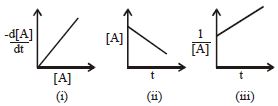
Consider the plots for the types of reaction. $nA \to  B + C$ These plots respectively corresponds to the reaction orders