The number density of free electrons in copper is nearly $8 \times 10^{28}\,m ^{-3} . A$ copper wire has its area of cross section $=2 \times 10^{-6}\,m ^2$ and is carrying a current of $3.2\,A$. The drift speed of the electrons is $.....\times 10^{-6}\,ms ^{-1}$.
JEE MAIN 2023, Easy
Download our app for free and get started
$n =8 \times 10^{28}\,m ^{-3}$
Area $=2 \times 10^{-6}\,m ^2$
$I=3.2\,A$
$I = neAv_{d }$
$V_{ d }=\frac{ I }{ neA }=125 \times 10^{-6}\,m / s$

Download our appand get started for free
Experience the future of education. Simply download our apps or reach out to us for more information. Let's shape the future of learning together!No signup needed.*
Similar Questions
- 1View SolutionThe internal resistance of a cell is the resistance of
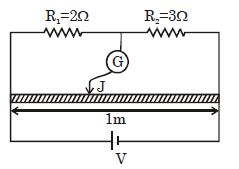
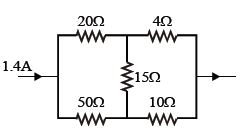
- 2In the given figure the current through $4\,\Omega$ resistor is .................. $\mathrm{A}$View Solution
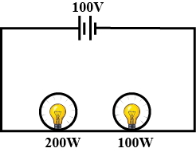
- 3Two bulbs, one of $200 \,W$ and the other of $100 \,W$ are connected in series with a $100 \,V$ battery which has no internal resistance. Then,View Solution
- 4A student is provided with a variable voltage source $V$, a test resistor $R_T=10\,\Omega$, two identical galvanometers $G_1$ and $G_2$ and two additional resistors, $R _1=10\,M\,\Omega$ and $R _2=0.001\,\Omega$. For conducting an experiment to verify ohms law, the most suitable circuit is:View Solution
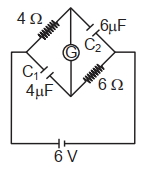
- 5A galvanometer $(G)$ $\Omega$ of 2 risistance is connected in the givn circuit the raito of charge in $C_1$ and $C_2$ is:View Solution
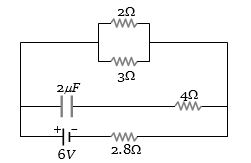
- 6In the figure shown, the capacity of the condenser $C$ is $2\,\mu F$. The current in $2\,\Omega $ resistor is ............... $A$View Solution
- 7View SolutionA constant voltage is applied between the two ends of a uniform metallic wire. Some heat is developed in it. The heat developed is double if
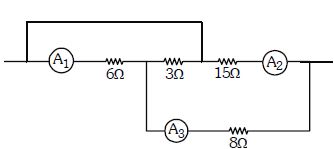
- 8A part of circuit is shown in figure. All the ammeters are ideal. If reading of ammeter $A_1$ is $1.0\ A$ , thenView Solution
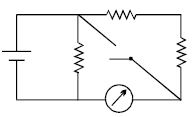
- 9In the circuit shown, the reading of the Ammeter is doubled after the switch is closed. Each resistor has a resistance $ = 1\,\Omega $ and the ideal cell has an $e.m.f. = 10\, V$. Then, the Ammeter has a coil resistance equal to ................ $\Omega$View Solution
- 10In a meter bridge experiment, initially the jockey is at null point. Now resistance $R_1$ $\&$ $R_2$ is interchanged. Shift in the position of jockey is ................ $cm$View Solution