MCQ
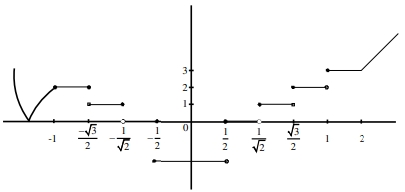
The number of points where the function

$f(x)=\left\{\begin{array}{clr}\left|2 x^{2}-3 x-7\right| \, \text { if } x \leq-1 \\ {\left[4 x^{2}-1\right]} \text { if } -1 < x < 1 \\ |x+1|+|x-2| \text { if } x \geq 1\end{array}\right.$

$[t]$ denotes the greatest integer $\leq t$, is discontinuous is

  • A
    $9$
  • B
    $8$
  • C
    $6$
  • $7$

Answer

Correct option: D.
$7$
d

Need a full question paper?

Generate a complete, print-ready paper with questions like this in minutes — across 16+ boards, with answer keys.

Start Generating Free

Similar questions

The value of $\mathop {\lim }\limits_{x \to 0} {(\cos ax)^{cosec{^2}\ bx}}$ is-
Direction ratios of the normal to the plane passing through the points $(0, 1, 1), (1, 1, 2)$ and $(-1, 2, -2)$ are
If ${z_1},{z_2},{z_3}$ are affixes of the vertices $A,B$ and $C$ respectively of a triangle $ABC$ having centroid at $G$ such that $z = 0$ is the mid point of $AG,$ then
The number of words which can be made out of the letters of the word $MOBILE $when consonants always occupy odd places is
If $a,\,b,\,c$ are three unequal numbers such that $a,\,b,\,c$ are in $A.P.$ and $b -a, c -b, a$ are in $G.P.$, then $a : b : c$ is
In order that the function $f(x) = {(x + 1)^{1/x}}$ is continuous at $x = 0$, $f(0)$ must be defined as
The general solution of the differential equation $\log \left( {\frac{{dy}}{{dx}}} \right) = x + y$ is
Let $ABC$ be a triangle such that $\overrightarrow{ BC }=\overrightarrow{ a }, \overrightarrow{ CA }=\overrightarrow{ b }$, $\overrightarrow{ AB }=\overrightarrow{ c },|\overrightarrow{ a }|=6 \sqrt{2}, \quad|\overrightarrow{ b }|=2 \sqrt{3}$ and $\overrightarrow{ b } \cdot \overrightarrow{ c }=12$ Consider the statements.

$( S 1):|(\overrightarrow{ a } \times \overrightarrow{ b })+(\overrightarrow{ c } \times \overrightarrow{ b })|-|\overrightarrow{ c }|=6(2 \sqrt{2}-1)$

$( S 2): \angle ABC =\cos ^{-1}\left(\sqrt{\frac{2}{3}}\right)$. Then

If $r\,\sin \theta = 3,r = 4(1 + \sin \theta ),\,\,0 \le \theta \le 2\pi ,$ then $\theta = $
If the system of linear equations $2 x-3 y=\gamma+5$ ; $\alpha x+5 y=\beta+1$, where $\alpha, \beta, \gamma \in R$ has infinitely many solutions, then the value of $|9 \alpha+3 \beta+5 \gamma|$ is equal to