MCQ
The number of positive integral solutions $\left| {\,\,\begin{array}{*{20}{c}}{1 - \lambda }&2&1\\{ - 3}&\lambda &{ - 2}\\2&{ - 2}&{1 + \lambda }\end{array}\,\,} \right|$ $= 0$ is
  • A
    $0$
  • B
    $2$
  • $3$
  • D
    $1$

Answer

Correct option: C.
$3$
c

Need a full question paper?

Generate a complete, print-ready paper with questions like this in minutes — across 16+ boards, with answer keys.
Start Generating Free

Similar questions

If the Rolle's theorem holds for the function $f(x) = 2x^3 + ax^2 + bx$ in the interval $[-1, 1 ]$ for the point $c = \frac{1}{2}$ , then the value of $2a + b$ is
If domain of the function $\log _e\left(\frac{6 x^2+5 x+1}{2 x-1}\right)+\cos ^{-1}\left(\frac{2 x^2-3 x+4}{3 x-5}\right)$ is $(\alpha, \beta) \cup(\gamma, \delta]$, then $18\left(\alpha^2+\beta^2+\gamma^2+\delta^2\right)$ is equal to $....$.
Direction cosines of ray from P(1, −2, 4) to Q(−1, 1, −2) are:
The value of $f(0)$, so that the function $f(x) = \frac{{{{(27 - 2x)}^{1/3}} - 3}}{{9 - 3{{(243 + 5x)}^{1/5}}}},\,(x \ne 0)$ is continuous, is given by
Let $A$ and $B$ be two events. If $\text{P(A)}=0.2,\text{P(B)}=0.4,\text{P}(\text{A}\cup\text{B})=0.6$ then $P(A|B)$ is equal to
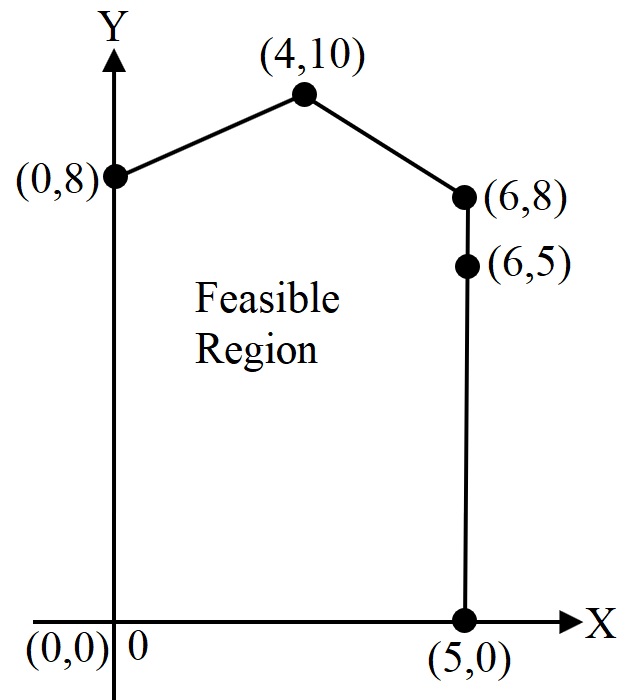
The feasible region for a $\text{LPP}$ is shown shaded in the figure. Let $Z = 3x - 4y$ be the objective function. Minimum of $Z$ occurs at.
The objective function Z = 4x + 3y can be maximised subjected to the constraints 3x + 4y ≤ 24, 8x + 6y ≤ 48, x ≤ 5, y ≤ 6, x, y ≥ 0
If $\text{A}=\frac{1}{\pi}\begin{bmatrix}\sin^{-1}(\pi\text{x})&\tan^{-1}(\frac{\text{x}}{\pi})\\\sin^{-1}(\frac{\text{x}}{\pi})&\cot^{-1}(\pi\text{x})\end{bmatrix},$ $\text{B}=\frac{1}{\pi}\begin{bmatrix}-\cos^{-1}(\pi\text{x})&\tan^{-1}(\frac{\text{x}}{\pi})\\\sin^{-1}(\frac{\text{x}}{\pi})&-\tan^{-1}(\pi\text{x})\end{bmatrix},$ then A - B is equal to:
The matrix $A^2 + 4A - 5I$, where $I$ is identity matrix and $A = \left[ {\begin{array}{*{20}{c}}
1&2\\
4&{ - 3}
\end{array}} \right]$ , equals
The image of the point (1, 3, 4) in the plane 2x - y + z + 3 = 0 is: