MCQ
The number of real values of $\lambda $ for which the system of linear equations $2x + 4y - \lambda  z = 0$ ;$4x + \lambda y + 2z = 0$ ; $\lambda x + 2y+ 2z = 0$ has infinitely many solutions, is
  • A
    $0$
  • $1$
  • C
    $2$
  • D
    $3$

Answer

Correct option: B.
$1$
b
Since the given system of linear equations has infinitely many solutions.

$\therefore \begin{array}{*{20}{c}}
2&4&{ - \lambda }\\
4&\lambda &2\\
\lambda &2&2
\end{array} = 0$

$ \Rightarrow {\lambda ^3} + 4\lambda  - 40 = 0$

$\lambda $ has only $1$ real root.

Need a full question paper?

Generate a complete, print-ready paper with questions like this in minutes — across 16+ boards, with answer keys.
Start Generating Free

Similar questions

The anti derivative of $\Big(\sqrt{\text{x}}+\frac{1}{\sqrt{\text{x}}}\Big)$ equals:
  1. $\frac{1}{3}\text{x}^\frac{1}{3}+2\text{x}^\frac{1}{2}+\text{c}$
  2. $\frac{2}{3}\text{x}^\frac{2}{3}+\frac{1}{2}\text{x}^{2}+\text{c}$
  3. $\frac{2}{3}\text{x}^\frac{3}{2}+2\text{x}^\frac{1}{2}+\text{c}$
  4. $\frac{3}{2}\text{x}^\frac{3}{2}+\frac{1}{2}\text{x}^\frac{1}{2}+\text{c}$
Which of the following function $(s)$ is/are periodic ?
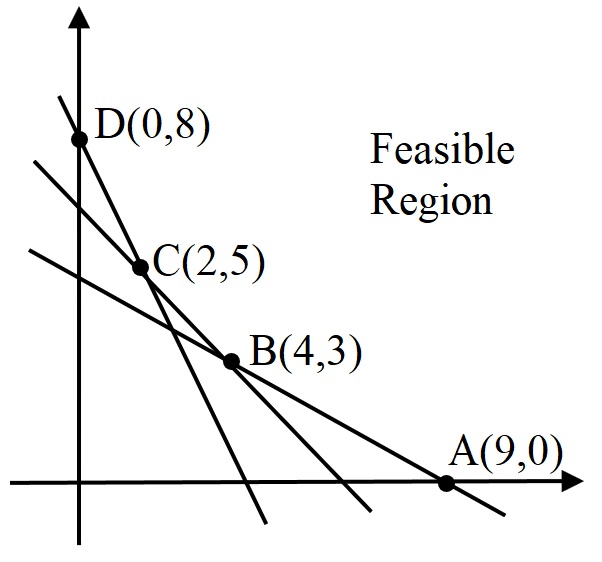
The feasible region for an LPP is shown shaded in the following figure. Minimum of Z = 4x + 3y occurs at the point.

Choose the correct answer
If $\theta$ is the angle between any two vectors $\vec{\text{a}}\ \text{and}\ \vec{\text{b}}, \text{then}\ |\vec{\text{a}}\cdot\vec{\text{b}}|=|\vec{\text{a}}\times\vec{\text{b}}|\ \text{when}\ \theta$ is equal to
  1. 0
  2. $\frac{\pi}{4}$
  3. $\frac{\pi}{2}$
  4. $\pi$
$\mathop \smallint \limits_0^\pi xf\left( {\sin x} \right)dx = $
The value of $C$ for which $P\,(X = k) = C{k^2}$ can serve as the probability function of a random variable $X$ that takes $0, 1, 2, 3, 4$ is
Area of the region $\left\{(x, y) \in \mathbb{R}^2: y \geq \sqrt{|x+3|}, 5 y \leq x+9 \leq 15\right\}$ is equal to
A boy tosses fair coin 3 times. If he gets $₹ 2 X$ for $X$ heads, then his expected gain (in ₹) equals to
The area enclosed by the curve $y={{\sin }^{-1}}\left( \cos x \right)$ and $y={{\cos }^{-1}}\left( \sin x \right)$ for $x\in \left[ \frac{\pi }{2},\frac{3\pi }{2} \right]$, is
If $S$ is the set of distinct values of $'b'$ for which the following system of linear equations $x + y + z = 1;x + ay + z = 1;ax + by + z = 0$ has no solution , then $S$ is :