Question
The one parameter that determines the brightness of a light source sensed by an eye is:
  1. Energy of light entering the eye per second.
  2. Wavelength of the light.
  3. Total radiant flux entering the eye.
  4. Total luminous flux entering the eye.

Answer

  1. Total luminous flux entering the eye.

Explanation:

Total luminous flux is the total brightness producing capability of a radiating source. Or, it is the measurement of the total energy entering our eyes that produces the sensation of vision.

  1. This cannot be the correct answer because all energies cannot be sensed by our eyes.
  2. This cannot be the correct answer because all wavelengths do not produce any sensation in our eyes.
  3. This cannot be the correct answer because all wavelengths contributing the radiant flux are not always visible to our eyes. There may be a large radiant flux yet there may not be any sensation of vision.

Need a full question paper?

Generate a complete, print-ready paper with questions like this in minutes — across 16+ boards, with answer keys.

Start Generating Free

Similar questions

An air bubble is formed inside water. Does it act as a converging lens or a diverging lens?
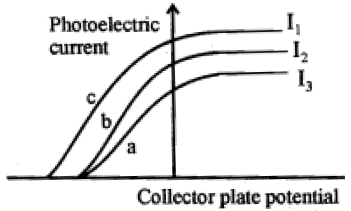
The figure shows a plot of three curves a, b, c showing the variation of photocurrent vs collector plate potential for three different intensities I1, I2 and I3 having frequencies $\sqrt{1} ,\sqrt{2}$ and $\sqrt{3}$, respectively incident on a photosensitive surface.

Point out the two curves for which the incident radiations have same frequency but different intensities.


In the circuit shown below, the potential at point A is 100 volts. What will be the potential at point B?
Comment on the following statement: the temperature of all the molecules in a sample of a gas is the same.
Calculate the minimum energy needed to separate a neutron from a nucleus with Z protons and N neutrons it terms of the masses MZ.N, MZ,N-1 and the mass of the neutron.
What is the relation between peak value and root mean square value of alternating voltage?
Answer carefully:
We know that electric field is discontinuous across the surface of a charged conductor. Is electric potential also discontinuous there?
Can a hot-wire ammeter be used to measure a direct current having a constant value? Do we have to change the graduations?
The magnifying power of a simple microscope will be maximum for which colour of light and minimum for which colour of light?
Can the earth's magnetic field be vertical at a place? What will happen to a lreely suspended magnet at such a place? What is the value of dip here?