MCQ
The only property possessed by ferromagnetic substance is
  • Hysteresis
  • B
    Susceptibility
  • C
    Directional property
  • D
    Attracting magnetic substances

Answer

Correct option: A.
Hysteresis
(a)

Need a full question paper?

Generate a complete, print-ready paper with questions like this in minutes — across 16+ boards, with answer keys.
Start Generating Free

Similar questions

A particle of mass $M$ at rest decays into two particles of masses $m$ and $m$, having non-zero velocities. The ratio of the de-Broglie wavelengths of the particles, $\lambda_1 / \lambda_2$ is
A body falls from rest in the gravitational field of the earth. The distance travelled in the fifth second of its motion is $\left(g=10 m / s^2\right)$
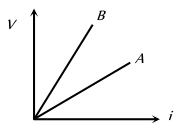
$V_{-i}$ graphs for parallel and series combination of two identical resistors are as shown in figure. Which graph represents parallel combination

Image

The value of ' $g$ ' at a particular point is $9.8 \mathrm{~m} / \mathrm{s}^2$. Suppose the earth suddenly shrinks uniformly to half its present size without losing any mass. The value of ' $g$ ' at the same point (assuming that the distance of the point from the centre of earth does not shrink) will now be
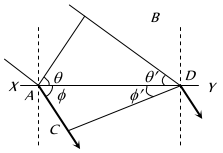
In the adjoining diagram, a wavefront $A B$, moving in air is incident on a plane glass surface $X Y$. Its position $C D$ after refraction through a glass slab is shown also along with the normals drawn at $A$ and $D$. The refractive index of glass with respect to air ( $\mu=1$ ) will be equal to
Image
If $x=a \sin \left(\omega t+\frac{\pi}{6}\right)$ and $x^{\prime}=a \cos \omega t$, then what is the phase difference between the two waves
A sphere collides with another sphere of identical mass. After collision, the two spheres move. The collision is inelastic. Then the angle between the directions of the two spheres is
A galvanometer of resistance $20 \Omega$ is to be converted into an ammeter of range $1 A$. If a current of $1 \mathrm{~mA}$ produces full scale deflection, the shunt required for the purpose is
A uniform plank of Young's modulus $Y$ is moved over a smooth horizontal surface by a constant horizontal force $F$. The area of cross section of the plank is $A$. The compressive strain on the plank in the direction of the force is
Two springs have their force constant as $k_1$ and $k_2\left(k_1>k_2\right)$. When they are stretched by the same force