Question

The orbital wave function or $\psi$ for an electronin an atom has no physical meaning. It issimply a mathematical function of thecoordinates of the electron. However, fordifferent orbitals the plots of correspondingwave functions as a function of r (the distancefrom the nucleus) are different. According to the German physicist, MaxBorn, the square of the wave function(i.e.,$\psi^2$) at a point gives the probability densityof the electron at that point. Boundary surface diagrams of constantprobability density for different orbitals give afairly good representation of the shapes of theorbitals. In this representation, a boundarysurface or contour surface is drawn in spacefor an orbital on which the value of probabilitydensity $\mid\psi\mid2$ is constant. In principle manysuch boundary surfaces may be possible.However, for a given orbital, only thatboundary surface diagram of constantprobability density* is taken to be goodrepresentation of the shape of the orbital whichencloses a region or volume in which theprobability of finding the electron is very high,say, 90%.
In hydrogen atom, electron has the same energy when it is in the2s orbital as when it is present in 2p orbital.The orbitals having the same energy are calleddegenerate. The 1s orbital in a hydrogenatom, as said earlier, corresponds to the moststable condition and is called the ground stateand an electron residing in this orbital is moststrongly held by the nucleus.
An electron inthe 2s, 2p or higher orbitals in a hydrogen atomis in excited state.The filling of electrons into the orbitals ofdifferent atoms takes place according to theaufbau principle which is based on the Pauli’sexclusion principle, the Hund’s rule ofmaximum multiplicity and the relativeenergies of the orbitals. Theaufbausprinciple states : In the ground state of theatoms, the orbitals are filled in order oftheir increasing energies. In other words,electrons first occupy the lowest energy orbitalavailable to them and enter into higher energyorbitals only after the lower energy orbitals arefilled.The number of electrons to be filled in variousorbitals is restricted by the exclusion principle,given by the Austrian scientist Wolfgang Pauli(1926). According to this principle : No twoelectrons in an atom can have the sameset of four quantum numbers. Pauliexclusion principle can also be stated as : “Onlytwo electrons may exist in the same orbitaland these electrons must have oppositespin.” This means that the two electrons canhave the same value of three quantum numbersn, l and $m_l$, but must have the opposite spinquantum number.Hund’s Rule of Maximum Multiplicity rule deals with the filling of electrons into the orbitals belonging to the same subshell. It states : pairing ofelectrons in the orbitals belonging to thesame subshell (p, d or f) does not take placeuntil each orbital belonging to thatsubshell has got one electron each i.e., itis singly occupied.
The distribution of electrons into orbitals of anatom is called its electronic configuration.If one keeps in mind the basic rules whichgovern the filling of different atomic orbitals,the electronic configurations of different atomscan be written very easily.The electronic configuration of differentatoms can be represented in two ways. Forexample :
  1. $s^a p^bd^c$​​​​​​​…… notation
  2. Orbital diagram
  1. …at a point gives the probability density of the electron at that point.
  1. $\psi\times2$
  2. $-\psi^2$
  3. $\psi$
  4. $\psi^2$
  1. Only …. electrons may exist in the same orbital and these electrons must have opposite spin.
  1. One
  2. Two
  3. Three
  4. Four
  1. …deals with the filling of electrons into the orbitals belonging to the same subshell.
  1. Hund’s Rule of Maximum Multiplicity rule
  2. Pauli’s exclusion principle
  3. Aufbau principle
  4. Werner Heisenberg
  1. Electrons first occupy the …. energy orbital available to them and enter into … energy orbitals.
  1. Lowest, Higher
  2. Higher, Lowest
  3. Middle, Higher
  4. Higher, Middle

Answer

  1. (d) $\psi^2$
  1. (b) Two
  1. (a) Hund’s Rule of Maximum Multiplicity rule
  1. (a)Lowest, Higher

Need a full question paper?

Generate a complete, print-ready paper with questions like this in minutes — across 16+ boards, with answer keys.

Start Generating Free

Similar questions

Read the passage given below and answer the following questions from $(i)$ to $(v).$
Predicting the Direction of the Reaction- The equilibrium constant helps in predicting the direction in which a given reaction will proceed at any stage. For this purpose, we calculate the reaction quotient $Q$. The reaction quotient, $Q (Qc$ with molar concentrations and $QP$ with partial pressures$)$ is defined in the same way as the equilibrium constant Kc except that the concentrations in $Qc$ are not necessarily equilibrium values. For a general reaction:
$\text{a}\text{A}+\text{b}\text{B}\rightleftharpoons\text{c}\text{C}+\text{d}\text{D}$
$\text{Q}\text{c}=\frac{[\text{C}]^\text{c}[\text{D}]^\text{d}}{[\text{A}]^\text{a}[\text{B}]^\text{b}}$
Then,
If $Qc > Kc,$ the reaction will proceed in the direction of reactants (reverse reaction).
If $Qc < Kc,$ the reaction will proceed in the direction of the products (forward reaction).
If $Qc = Kc,$ the reaction mixture is already at equilibrium. Consider the gaseous reaction of $H_2$ with $I_2$ ,
$\text{H}_{2(\text{g})}+\text{l}_{2(\text{g})}\rightleftharpoons2\text{Hl}_{(\text{g})};\text{kc}=57.0\text{at}700\text{k}.$
Suppose we have molar concentrations $[H_2 ]t =0.10M, [I_2 ]t = 0.20 M$ and $[HI]t = 0.40 M.$ (the subscript t on the concentration symbols means that the concentrations were measured at some arbitrary time t, not necessarily at equilibrium). Thus, the reaction quotient, Qc at this stage of the reaction is given by,
$\text{Qc}=\frac{[\text{Hl}]\text{t}^2}{[\text{H}]^2]_\text{t}[\text{l}_2]_\text{t}}=\frac{(0.40)_2}{(0.10)\times(0.20)}=8.0$
Now, in this case, $Qc (8.0)$ does not equal Kc $(57.0)$, so the mixture of $H2 _{(g)}, I2 _{(g)} $ and $HI_{(g)} $ is not at equilibrium; that is, more $H2 _{(g)} $ and $I 2 _{(g)} $ will react to form more $HI_{(g)} $ and their concentrations will decrease till $Qc = Kc.$ The reaction quotient, Qc is useful in predicting the direction of reaction by comparing the values of Qc and Kc.Thus, we can make the following generalisations concerning the direction of the reaction
If $Qc < Kc,$ net reaction goes from left to right
If $Qc > Kc,$ net reaction goes from right to left.
If $Qc = Kc,$ no net reaction occurs.
Calculating Equilibrium Concentrations In case of a problem in which we know the initial concentrations but do not know any of the equilibrium concentrations, the following three steps shall be followed:
Step 1) Write the balanced equation for the reaction.
Step 2) Under the balanced equation, make a table that lists for each substance involved in the reaction: $(a)$ the initial concentration, $(b)$ the change in concentration on going to equilibrium, and $(c)$ the equilibrium concentration. In constructing the table, define $x$ as the concentration (mol/L) of one of the substances that reacts on going to equilibrium, then use the stoichiometry of the reaction to determine the concentrations of the other substances in terms of $x.$
Step 3) Substitute the equilibrium concentrations into the equilibrium equation for the reaction and solve for x. If you are to solve a quadratic equation choose the mathematical solution that makes chemical sense.
Step 4) Calculate the equilibrium concentrations from the calculated value of $x.$
Step 5) Check your results by substituting them into the equilibrium equation.
Relationship between equilibrium constant K, reaction quotient Q and gibbs energy G The value of Kc for a reaction does not depend on the rate of the reaction. However, it is directly related to the thermodynamics of the reaction and in particular, to the change in Gibbs energy, $\triangle\text{G}.$ If,
$\triangle\text{G}$ is negative, then the reaction is spontaneous and proceeds in the forward direction.
$\triangle\text{G}$ is positive, then reaction is considered non-spontaneous. Instead, as reverse reaction would have a negative $\triangle\text{G},$ the products of the forward reaction shall be converted to the reactants.
$\triangle\text{G}$ is 0, reaction has achieved equilibrium; at this point, there is no longer any free energy left to drive the reaction. A mathematical expression of this thermodynamic view of equilibrium can be described by the following equation:
$\triangle\text{G}=\triangle\text{G}^\phi+\text{RT}\text{lnQ}$
where, $\triangle\text{G}^\phi$ is standard Gibbs energy. At equilibrium, when $\triangle\text{G}=0$ and $Q = Kc,$ the equation becomes,
$\triangle\text{G}=\text{G}^\phi+\text{RT}\text{lnk}=0$
$\triangle\text{G}^\phi=-\text{RT}\text{lnk}$
$\text{Ink}=\frac{-\triangle\text{G}^\phi}{\text{RT}}$
Taking antilog of both sides, we get,
$\text{K}=\text{e}-\frac{\triangle\text{G}0}{\text{RT}}$
Hence, using the equation, the reaction spontaneity can be interpreted in terms of the value of $\triangle\text{G}^\phi.$
If $\triangle\text{G}^\phi>0$ then $\frac{-\triangle\text{G}^\phi}{\text{RT}}$ is positive, and $>1$, making $K > 1$, which implies a spontaneous reaction or the reaction which proceeds in the forward direction to such an extent that the products are present predominantly.
If $\triangle\text{G}^\phi>0,$ then $\frac{-\triangle\text{G}^\phi}{\text{RT}}$ is negative, and $< 1$, that is, $K < 1$, which implies a non-spontaneous reaction or a reaction which proceeds in the forward direction to such a small degree that only a very minute quantity of product is formed.
Factors affecting equilibria One of the principal goals of chemical synthesis is to maximise the conversion of the reactants to products while minimizing the expenditure of energy. This implies maximum yield of products at mild temperature and pressure conditions. If it does not happen, then the experimental conditions need to be adjusted. For example, in the Haber process for the synthesis of ammonia from $N_2$ and $H_2,$ the choice of experimental conditions is of real economic importance. Annual world production of ammonia is about hundred million tones, primarily for use as fertilizers. Equilibrium constant, Kc is independent of initial concentrations. But if a system at equilibrium is subjected to a change in the concentration of one or more of the reacting substances, then the system is no longer at equilibrium; and net reaction takes place in some direction until the system returns to equilibrium once again. Similarly, a change in temperature or pressure of the system may also alter the equilibrium. In order to decide what course the reaction adopts and make a qualitative prediction about the effect of a change in conditions on equilibrium we use Le Chatelier’s principle. It states that a change in any of the factors that determine the equilibrium conditions of a system will cause the system to change in such a manner so as to reduce or to counteract the effect of the change. This is applicable to all physical and chemical equilibria.
Effect of Concentration Change In general, when equilibrium is disturbed by the addition/removal of any reactant/ products, Le Chatelier’s principle predicts that:
The concentration stress of an added reactant/product is relieved by net reaction in the direction that consumes the added substance.
The concentration stress of a removed reactant/product is relieved by net reaction in the direction that replenishes the removed substance. or in other words, “When the concentration of any of the reactants or products in a reaction at equilibrium is changed, the composition of the equilibrium mixture changes so as to minimize the effect of concentration changes”. Let us take the reaction,
$\text{H}_{2(\text{g})}+\text{l}_{2(\text{g})}\rightleftharpoons2\text{Hl}_{(\text{g})}$
If $H_2$ is added to the reaction mixture at equilibrium, then the equilibrium of the reaction is disturbed. In order to restore it, the reaction proceeds in a direction wherein $H_2$ is consumed, i.e., more of $H_2$ and $I_2$ react to form HI and finally the equilibrium shifts in right (forward) direction. This is in accordance with the Le Chatelier’s principle which implies that in case of addition of a reactant/product, a new equilibrium will be set up in which the concentration of the reactant/product should be less than what it was after the addition but more than what it was in the original mixture. The same point can be explained in terms of the reaction quotient, $Qc,$​​​​​​​​​​​​​​
Case Study Questions Class 11 Chemistry – Equilibrium
$\text{Qc}=\frac{[\text{HI}]^2}{[\text{H}]_2[\text{I}]_2}$
Addition of hydrogen at equilibrium results in value of $Qc$ being less than $Kc$. Thus, in order to attain equilibrium again reaction moves in the forward direction. Similarly, we can say that removal of a product also boosts the forward reaction and increases the concentration of the products and this has great commercial application in cases of reactions, where the product is a gas or a volatile substance. In case of manufacture of ammonia, ammonia is liquified and removed from the reaction mixture so that reaction keeps moving in forward direction. Similarly, in the large scale production of $CaO$ (used as important building material) from $CaCO_3$, constant removal of $CO_2$ from the kiln drives the reaction to completion. It should be remembered that continuous removal of a product maintains Qc at a value less than Kc and reaction continues to move in the forward direction.
  1. If … the reaction will proceed in the direction of reactants (reverse reaction).
  1. $Qc > Kc$
  2. $Qc < Kc$
  3. $Qc = Kc$
  4. None of above
  1. If … the reaction will proceed in the direction of the products (forward reaction).
  1. $Qc > Kc$
  2. $Qc < Kc$
  3. $Qc = Kc$
  4. None of above
  1. If … the reaction mixture is already at equilibrium. Consider the gaseous reaction.
  1. $Qc > Kc$
  2. $Qc < Kc$
  3. $Qc = Kc$
  4. All of above
  1. If $\triangle\text{G}$ is …. then the reaction is spontaneous and proceeds in the forward direction.
  1. Zero
  2. Positive
  3. Negative
  4. None of above
  1. $\triangle\text{G}$ is … reaction has achieved equilibrium; at this point, there is no longer any free energy left to drive the reaction.
  1. Zero
  2. Positive
  3. Negative
  4. None of above
Read the passage given below and answer the following questions from (i) to (v).
A system in thermodynamics refers to that part of universe in which observations are made and remaining universe constitutes the surroundings. The surroundings include everything other than the system. System and the surroundings together constitute the universe. The universe = The system + The surroundings However, the entire universe other than the system is not affected by the changes taking place in the system. Therefore, for all practical purposes, the surroundings are that portion of the remaining universe which can interact with the system. Usually, the region of space in the neighbourhood of the system constitutes its surroundings.
The wall that separates the system from the surroundings is called boundary.
Types of the System We, further classify the systems according to the movements of matter and energy in or out of the system.
  1. Open System In an open system, there is exchange of energy and matter between system and surroundings. The presence of reactants in an open beaker is an example of an open system. Here the boundary is an imaginary surface enclosing the beaker and reactants.
  2. Closed System In a closed system, there is no exchange of matter, but exchange of energy is possible between system and the surroundings. The presence of reactants in a closed vessel made of conducting material e.g., copper or steel is an example of a closed system.
  3. Isolated System In an isolated system, there is no exchange of energy or matter between the system and the surroundings. The presence of reactants in a thermos flask or any other closed insulated vessel is an example of an isolated system.
The State of the System The system must be described in order to make any useful calculations by specifying quantitatively each of the properties such as its pressure (p), volume (V), and temperature (T) as well as the composition of the system. We need to describe the system by specifying it before and after the change. You would recall from your Physics course that the state of a system in mechanics is completely specified at a given instant of time, by the position and velocity of each mass point of the system. In thermodynamics, a different and much simpler concept of the state of a system is introduced. It does not need detailed knowledge of motion of each particle because, we deal with average measurable properties of the system. We specify the state of the system by state functions or state variables. The state of a thermodynamic system is described by its measurable or macroscopic (bulk) properties. We can describe the state of a gas by quoting its pressure (p), volume (V), temperature (T), amount (n) etc. Variables like p, V, T are called state variables or state functions because their values depend only on the state of the system and not on how it is reached. In order to completely define the state of a system it is not necessary to define all the properties of the system; as only a certain number of properties can be varied independently. This number depends on the nature of the system. Once these minimum number of macroscopic properties are fixed, others automatically have definite values. The state of the surroundings can never be completely specified; fortunately it is not necessary to do so.
By conventions of IUPAC in chemical thermodynamics. The q is positive, when heat is transferred from the surroundings to the system and the internal energy of the system increases and q is negative when heat is transferred from system to the surroundings resulting in decrease of the internal energy of the system.
Let us consider the general case in which a change of state is brought about both by doing work and by transfer of heat. We write change in internal energy for this case as: $ \triangle{\text{U}}=\text{q}+\text{w}$
For a given change in state, q and w can vary depending on how the change is carried out. However, $\text{q}+\text{w}=\triangle{\text{U}}$ will depend only on initial and final state. It will be independent of the way the change is carried out. If there is no transfer of energy as heat or as work (isolated system) i.e., if w = 0 and q = 0, then $ \triangle{\text{U}}=0.$ The equation i.e., $ \triangle{\text{U}}=\text{q}+\text{w}$ is mathematical statement of the first law of thermodynamics, which states that The energy of an isolated system is constant. It is commonly stated as the law of conservation of energy i.e., energy can neither be created nor be destroyed.
  1. $\triangle\text{U}=\ ....$
  1. q + w
  2. q + v
  3. q + m
  4. q + z
  1. Which of the following is not an example of state variable?
  1. Pressure
  2. Ionic radius
  3. Volume
  4. Amount
  1. $\triangle\text{U}=\text{q}+\text{w}$ is termed as …
  1. Third law of thermodynamics
  2. Second law of thermodynamics
  3. First law of thermodynamics
  4. None of above
  1. A … in thermodynamics refers to that part of universe in which observations are made.
  1. Universe
  2. System
  3. Surrounding
  4. Boundary
  1. Which of the following is a type if system ?
  1. Open system
  2. Closed system
  3. Lsolated system
  4. All the above
Read the passage given below and answer the following questions from (i) to (v).
Arrhenius Concept of Acids and Bases According to Arrhenius theory, acids are substances that dissociates in water to give hydrogen ions $H ^{+}{ }_{(a q)}$ and bases are substances that produce hydroxyl ions $OH ^{-}{ }_{( aq )}$. The ionization of an acid $HX { }_{\text {(aq) }}$ can be represented by the following equations:
$HX_{(aq)} \rightarrow H^{+}{ }_{(aq)}+X_{(aq)}^{-}$
or
$HX_{(aq)}+H_2 O(l) \rightarrow H_3 O^{+}{ }_{(aq)}+X_{(aq)}^{-}$
A bare proton, $H ^{+}$is very reactive and cannot exist freely in aqueous solutions. Thus, it bonds to the oxygen atom of a solvent water molecule to give trigonal pyramidal hydronium ion, $H _3 O ^{+}\left\{\left[ H \left( H _2 O \right)\right]^{+}\right\}$(see box). In this chapter we shall use $H ^{+}{ }_{( aq )}$ and $H _3 O ^{+}{ }_{( aq )}$ interchangeably to mean the same i.e., a hydrated proton. Similarly, a base molecule like MOH ionizes in aqueous solution according to the equation:
$MOH_{(aq)} \rightarrow M^{+}{ }_{(aq)}+OH^{-}(aq)$
The hydroxyl ion also exists in the hydrated form in the aqueous solution. Arrhenius concept of acid and base, however, suffers from the limitation of being applicable only to aqueous solutions and also, does not account for the basicity of substances like, ammonia which do not possess a hydroxyl group.
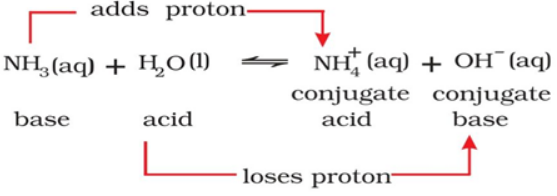
The Brönsted-Lowry Acids and Bases The Danish chemist, Johannes Brönsted and the English chemist, Thomas M. Lowry gave a more general definition of acids and bases. According to Brönsted-Lowry theory, acid is a substance that is capable of donating a hydrogen ion $H ^{+}$and bases are substances capable of accepting a hydrogen ion, $H ^{+}$. In short, acids are proton donors and bases are proton acceptors. Consider the example of dissolution of $NH _3$ in $H _2 O$ represented by the following equation:

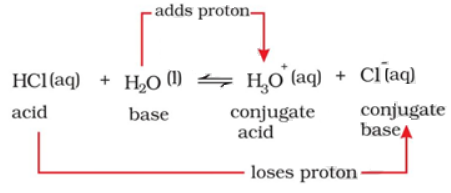
Hydronium and Hydroxyl lons Hydrogen ion by itself is a bare proton with very small size ( $\sim 10-15 m$ radius) and intense electric field, binds itself with the water molecule at one of the two available lone pairs on it giving $H _3 O ^{+}$. This species has been detected in many compounds (e.g., $H _3 O ^{+} Cl -$ ) in the solid state. In aqueous solution the hydronium ion is further hydrated to give species like $H _5 O _2^{+}, H7O3^{+}$and $H _9 4^{+}$. Similarly the hydroxyl ion is hydrated to give several ionic species like, $H _5 O 3$ - and H 7 O 4 - etc. The basic solution is formed due to the presence of hydroxyl ions. In this reaction, water molecule acts as proton donor and ammonia molecule acts as proton acceptor and are thus, called Lowry-Brönsted acid and base, respectively. In the reverse reaction, $H ^{+}$is transferred from $NH _4^{+}$to $OH ^{-}$. In this case, $NH _4^{+}$acts as a Bronsted acid while $OH ^{-}$acted as a Brönsted base. The acid-base pair that differs only by one proton is called a conjugate acid-base pair. Therefore, OH - is called the conjugate base of an acid $H _2 O$ and $NH _4{ }^{+}$is called conjugate acid of the base $NH _3$. f Brönsted acid is a strong acid then its conjugate base is a weak base and vice- versa. It may be noted that conjugate acid has one extra proton and each conjugate base has one less proton. Consider the example of ionization of hydrochloric acid in water. $HCl _{( aq )}$ acts as an acid by donating a proton to $H _2 O$ molecule which acts as a base.

It can be seen in the above equation, that water acts as a base because it accepts the proton. The species $H _3 O ^{+}$is produced when water accepts a proton from HCl . Therefore, Cl - is a conjugate base of HCl and HCl is the conjugate acid of base $Cl -$. Similarly, $H _2 O$ is a conjugate base of an acid $H _3 O ^{+}$and $H _3 O ^{+}$is a conjugate acid of base $H _2 O$. It is interesting to observe the dual role of water as an acid and a base. In case of reaction with HCl water acts as a base while in case of ammonia it acts as an acid by donating a proton.
Lewis Acids and Bases G.N. Lewis in 1923 defined an acid as a species which accepts electron pair and base which donates an electron pair. As far as bases are concerned, there is not much difference between Brönsted-Lowry and Lewis concepts, as the base provides a lone pair in both the cases. However, in Lewis concept many acids do not have proton. A typical example is reaction of electron deficient species $BF _3$ with $NH _3 . BF _3$ does not have a proton but still acts as an acid and reacts with $NH _3$ by accepting its lone pair of electrons. The reaction can be represented by, $BF _3+: NH _3 \rightarrow BF _3: NH _3$
Electron deficient species like $AlCl _3, Co ^{3+}, Mg ^{2+}$, etc. can act as Lewis acids while species like $H _2 O , NH _3, OH ^{-}$etc. which can donate a pair of electrons, can act as Lewis bases.
The pH Scale Hydronium ion concentration in molarity is more conveniently expressed on a logarithmic scale known as the pH scale. The pH of a solution is defined as the negative logarithm to base 10 of the activity ( $a _{ H }{ }^{+}$) of hydrogen ion. In dilute solutions ( $<0.01 M$ ), activity of hydrogen ion $\left( H ^{+}\right)$is equal in magnitude to molarity represented by $\left[ H ^{+}\right]$. It should be noted that activity has no units and is defined as:
$\text{a}=\frac{[\text{H}^+]}{\text{mol}\text{L}^{–1}}$
From the definition of pH, the following can be written,
$\text{pH}={–\log\text{a}_\text{H}^+=\frac{-\log[\text{H}^+]}{\text{mol}\text{L}^{–1}}}$
Thus, an acidic solution of HCl (10–2M) will have a pH = 2. Similarly, a basic solution of NaOH having $[OH^–] =10^{–4}​​​​​​​$​​​​​​​M and [ $H_3O^+] = 10^{–10}M$ will have a $pH = 10. At 25 ^\circ C$, pure water has a concentration of hydrogen ions,$ [H^+] = 10^{–7} M.$ Hence, the pH of pure water is given as:
$pH = –\log(10^{–7}) = 7$
Acidic solutions possess a concentration of hydrogen ions, $[H^+] > 10^{–7}​​​​​​​$​​​​​​​M, while basic solutions possess a concentration of hydrogen ions,$ [H^+] < 10^{–7}​​​​​​​$M. thus, we can summarise that
Acidic solution has pH < 7
Basic solution has pH > 7
Neutral solution has pH = 7
Now again, consider the equation at 298K
$Kw = [H_3O^+][OH^–] = 10^{–14}​​​​​​​$​​​​​​​
Taking negative logarithm on both sides of equation, we obtain
$–\log Kw = – \log{[ H_3O^+ ][OH– ]}$
$= – \log[H_3O^+] – \log[OH–]$
$= – log10^{–14}$
$pKw = pH + pOH = 14$
Note that although Kw may change with temperature the variations in pH with temperature are so small that we often ignore it. pKw is a very important quantity for aqueous solutions and controls the relative concentrations of hydrogen and hydroxyl ions as their product is a constant. It should be noted that as the pH scale is logarithmic, a change in pH by just one unit also means change in $\left[ H ^{+}\right]$by a factor of 10 . Similarly, when the hydrogen ion concentration, $\left[ H ^{+}\right]$changes by a factor of 100 , the value of pH changes by 2 units. Now you can realise why the change in pH with temperature is often ignored. Ionization Constants of Weak Acids Consider a weak acid HX that is partially ionized in the aqueous solution. The equilibrium can be expressed by::
$HX_{(aq)}+H_2O(l) \rightarrow H_3O^+_{(aq)} + X^–_{(aq)}​​​​​​​$
Initial concentration (M)
c 0 0
Let α be the extent of ionization Change (M) -cα +cα +cα Equilibrium concentration (M) c-cα cα cα Here, c = initial concentration of the undissociated acid, HX at time, t = 0. α = extent up to which HX is ionized into ions. Using these notations, we can derive the equilibrium constant for the above discussed acid- dissociation equilibrium:
$\text{Ka}=\frac{\text{c}^2\alpha^2}{\text{c}(1-\alpha)}=\frac{\text{c}\alpha^2}{1-\alpha}$
Ka is called the dissociation or ionization constant of acid HX. It can be represented alternatively in terms of molar concentration as follows,
$\text{Ka}=\frac{[\text{H}^+][\text{X}^–]}{[\text{HX}]}$
At a given temperature T, Ka is a measure of the strength of the acid HX i.e., larger the value of Ka, the stronger is the acid. Ka is a dimensionless quantity with the understanding that the standard state concentration of all species is 1M.
  1. … is a substance that is capable of donating a hydrogen ion $H^+.$
  1. Acid
  2. Base
  3. Neutral substances
  4. Alkaline
  1. … are proton acceptors.
  1. Acids
  2. Bases
  3. Neutral substances
  4. All the above
  1. According to …bases are substances that produce hydroxyl ions $OH^–.$
  1. Johannes Brönsted
  2. Thomas M. Lowry
  3. Arrhenius
  4. G. N. Lewis
  1. Brönsted acid is a strong acid then its conjugate base is a … base.
  1. Strong
  2. Medium
  3. Non
  4. Weak
  1. According to … an acid as a species which accepts electron pair.
  1. Johannes Brönsted
  2. Thomas M. Lowry
  3. Arrhenius
  4. G. N. Lewis
Read the passage given below and answer the following questions from 1 to 5.
Hydrogen Peroxide $(H_2O_2)$ Hydrogen peroxide is an important chemical used in pollution control treatment of domestic and industrial effluents.It can be prepared by the following methods.
i) Acidifying barium peroxide and removing excess water by evaporation under reduced pressure gives hydrogen.
$\text{BaO}_2.8\text{H}_2\text{O}(\text{s})+\text{H}_2\text{SO}_4\text{(aq)}\rightarrow\text{BaSO}_4\text{(s)}+\text{H}_2\text{O}_2\text{(aq)}+8\text{H}_2\text{O}\text{l}$
ii) Peroxodisulphate, obtained by electrolytic oxidation of acidified sulphate solutions at high current density, on hydrolysis yields hydrogen.
$2\text{HSO}_\bar{4}(\text{aq})\xrightarrow{\text{Electrolysis}}\text{HO}_3\text{SOOSO}_3\text{H}(\text{aq})\xrightarrow{\text{Hydrolysis}}2\text{HSO}_\bar{4}\text{(aq)}+2\text{H}^+\text{(aq)}+\text{H}_2\text{O}_2\text{aq}$
This method is now used for the laboratory preparation of $D_2O_{2.}$
_{$\text{K}_2\text{S}_2\text{O}_8(\text{s})+2\text{D}_2\text{O}\text{(l)}\rightarrow2\text{KDSO}_4(\text{aq})+\text{D}_2\text{O}_2\text{(l)}$}
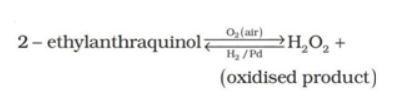
iii) Industrially it is prepared by the auto- oxidation of 2-alklylanthraquinols. 2 ethylanthraquinol H O oxidised product.

In this case 1% $H_2O_2$ is formed. It is extracted with water and concentrated to $\sim30\%$ (by mass) by distillation under reduced pressure. It can be further concentrated to $\sim85\%$ by careful distillation under low pressure. The remaining water can be frozen out to obtain pure $H_2O_2$. Physical Properties of the pure state $H_2O_2$ is an almost colourless (very pale blue) liquid. Its important physical properties. $H_2O_2$ is miscible with water in all proportions and forms a hydrate $H_2O_2.$ $H_2O$ (mp 221K). A 30% solution of $H_2O_2$ is marketed as ‘100 volume’ hydrogen peroxide. It means that one millilitre of 30% $H_2O_2$ solution will give 100 mL of oxygen at STP. Commercially marketed sample is 10 V, which means that the sample contains 3% $H_2O_2$ . Structure Hydrogen peroxide has a non-planar structure.
$H_2O_2$ decomposes slowly on exposure to light.
$2\text{H}_2\text{O}_2\text{(l)}\rightarrow2\text{H}_2\text{O}(\text{l})+\text{O}_2\text{(g)}$
In the presence of metal surfaces or traces of alkali (present in glass containers), the above reaction is catalysed. It is, therefore, stored in wax-lined glass or plastic vessels in dark. Urea can be added as a stabiliser. It is kept away from dust because dust can induce explosive decomposition of the compound.
Its wide scale use has led to tremendous increase in the industrial production of $H_2O_2$. Some of the uses are listed below:
i) In daily life it is used as a hair bleach and as a mild disinfectant. As an antiseptic it is sold in the market as
ii) It is used to manufacture chemicals like sodium perborate and per – carbonate, which are used in high quality detergents.
iii) It is used in the synthesis of hydroquinone, tartaric acid and certain food products and pharmaceuticals (cephalosporin)
iv) It is employed in the industries as a bleaching agent for textiles, paper pulp, leather, oils, fats,
v) Nowadays it is also used in Environmental (Green) Chemistry. For example, in pollution control treatment of domestic and industrial effluents, oxidation of cyanides, restoration of aerobic conditions to sewage wastes,
Heavy water, $D_2O$ It is extensively used as a moderator in nuclear reactors and in exchange reactions for the study of reaction mechanisms. It can be prepared by exhaustive electrolysis of water or as a by-product in some fertilizer industries. It is used for the preparation of other deuterium compounds, for example:
Dihydrogen can be used as a fuel .Dihydrogen releases large quantities of heat on combustion. The data on energy released by combustion of fuels like dihydrogen, methane, LPG etc. are compared in terms of the same amounts in mole, mass and volume Hydrogen Economy is an alternative. The basic principle of hydrogen economy is the transportation and storage of energy in the form of liquid or gaseous dihydrogen. Advantage of hydrogen economy is that energy is transmitted in the form of dihydrogen and not as electric power. It is for the first time in the history of India that a pilot project using dihydrogen as fuel was launched in October 2005 for running automobiles. Initially 5% dihydrogen has been mixed in CNG for use in four-wheeler vehicles. The percentage of dihydrogen would be gradually increased to reach the optimum level. Nowadays, it is also used in fuel cells for generation of electric power. It is expected that economically viable and safe sources of dihydrogen will be identified in the years to come, for its usage as a common source of energy.
  1. In India, a pilot project using dihydrogen as fuel was launched in… for running automobiles.
  1. October 2005
  2. May 2004
  3. August 2014
  4. February 2010
  1. Structure Hydrogen peroxide has a … structure.
  1. Bilateral
  2. Non-planar
  3. Planar
  4. Cubic
  1. One millilitre of 30% $H_2O_2$ solution will give … mL of oxygen at STP.
  1. 30
  2. 10
  3. 100
  4. 300
  1. …. is extensively used as a moderator in nuclear reactors and in exchange reactions for the study of reaction mechanisms.
  1. $H_2O_2$
  2. $T_2O$
  3. $H_2O$
  4. $D_2O$
  1. Colour of pure state $H_2O_2$ is ..
  1. Very Pale red
  2. Very Pale yellow
  3. Very Pale green
  4. Very Pale blue
The ionic character of metallic halides tends toward covalent nature as per Fajan's rule. Such covalent halides behave as non-metal in their higher oxidation states. The property to hydrolyse to give oxy-acids of the element and corresponding hydro halogen acid for most non-metallic elements proceeds exceptionally in the way, keeping oxidation number of element and halide sam in oxo-acids.
Non-polar halides are immiscible in water, as they do not show hydrolysis, but halides of some elements with empty d-orbital undergo hydrolysis. Stability of halides of the higher state is governed by the inert-pair effect.

1. How does halide undergo hydrolysis to give oxy-acids of underlined element $PCl _3$ ? (1)
2. Out of $NCl _3$ and $BCl _3$ undergoes hydrolysis to form oxy-acids? Write the chemical reaction for the correct answer. (1)
3. Out of $PbCl _4, PbF _4, PbI _4$ and $PbBr _4$ which one doesn't exist? (2)
OR
Non-Polar halides are immiscible in water. Why? (2)
Read the passage given below and answer the following questions from 1 to 5.
Oxidation state and trends in chemical Reactivity Due to small size of boron, the sum of its first Three ionization enthalpies is very high. This Prevents it to form +3 ions and forces it to form Only covalent compounds. But as we move from B to Al, the sum of the first three ionisation Enthalpies of Al considerably decreases, and Is therefore able to form $Al^{3+}$ ions. In fact, Aluminium is a highly electropositive metal. However, down the group, due to poor Shielding effect of intervening d and f orbitals, The increased effective nuclear charge holds ns Electrons tightly (responsible for inert pair Effect) and thereby, restricting their Participation in bonding. As a result of this, Only p-orbital electron may be involved in Bonding. In fact in Ga, In and Tl, both +1 and +3 oxidation states are observed. The relative Stability of +1 oxidation state progressively Increases for heavier elements: A l< Ga < In< Tl. In Thallium +1 oxidation state is predominant whereas the +3 oxidation state is highly Oxidising in character. The compounds in +1 oxidation state, as expected from energy Considerations, are more ionic than those in +3 oxidation state.
Important trends and anomalous properties of boron – certain important trends can be observed in the chemical behaviour of group 13 elements. The tri-chlorides, bromides and iodides of all these elements being covalent in nature are hydrolysed in water. Species like tetrahedral $[M(OH)_4]^–$ and octahedral $[M(H_2O)6]^{3+}$, except in boron, exist in aqueous medium. The monomeric trihalides, being electron deficient, are strong Lewis acids. Boron trifluoride easily reacts with Lewis bases such as $NH_3$ to complete octet around boron. It is due to the absence of d orbitals that the maximum covalence of B is 4. Since the d orbitals are available with Al and other elements, the maximum covalence can be expected beyond 4. Most of the other metal halides (e.g., $AlCl_3$) are dimerised through halogen bridging (e.g., $Al2Cl_6$). The metal species completes its octet by accepting electrons from halogen in these halogen bridged molecules.
i) Reactivity towards air Boron is unreactive in crystalline form. Aluminium forms a very thin oxide layer on The surface which protects the metal from Further attack. Amorphous boron and Aluminium metal on heating in air form $B_2O_3$ And $Al_2O_3$ respectively. With dinitrogen at high Temperature they form nitrides. The nature of these oxides varies down the Group. Boron trioxide is acidic and reacts with Basic (metallic) oxides forming metal borates. Aluminium and gallium oxides are amphoteric And those of indium and thallium are basic in Their properties.
ii) Reactivity towards acids and alkalies Boron does not react with acids and alkalies Even at moderate temperature; but aluminium Dissolves in mineral acids and aqueous alkalies And thus shows amphoteric character. Aluminium dissolves in dilute HCl and Liberates dihydrogen.
$2Al(s) + 6HCl (aq) \rightarrow 2Al_3^+ (aq) + 6Cl^– (aq) + 3H_2 (g)$
However, concentrated nitric acid renders Aluminium passive by forming a protective Oxide layer on the surface. Aluminium also reacts with aqueous alkali And liberates dihydrogen.
$2Al (s) + 2NaOH(aq) + 6H_2O(l) \rightarrow 2 Na+ [Al(OH)_4]^– (aq) + 3H_2(g)$
Sodium Tetrahydroxoaluminate(III).
iii) Reactivity towards halogens These elements react with halogens to form Trihalides (except TlI3). $2E(s) + 3 X_2 (g) \rightarrow 2EX_3 (s) (X = F, Cl, Br, I)$
Borax- It is the most important compound of boron. It is a white crystalline solid of formula $Na_2B_4O_7⋅10H_2O$. In fact it contains the Tetranuclear units and correct Formula; therefore, is $Na2 [B4O5 (OH) 4].8H2O$. Borax dissolves in water to give an alkaline Solution.
$Na_2B_4O7 + 7H_2O \rightarrow 2NaOH + 4H_3BO_3$
On heating, borax first loses water Molecules and swells up. On further heating it Turns into a transparent liquid, which solidifies Into glass like material known as borax Bead. $Na_2B_4O_7.10H_2O \rightarrow Na^2B_4O_7\rightarrow 2NaBO_2+ B2O_3​​​​​​​$
Metaborate Boric Anhydride The metaborates of many transition metals Have characteristic colours and, therefore, Borax bead test can be used to identify them In the laboratory. For example, when borax is Heated in a Bunsen burner flame with CoO on A loop of platinum wire, a blue coloured Co(BO2) 2 bead is formed.
Orthoboric acid, $H_3BO_3$ is a white crystalline Solid, with soapy touch. It is sparingly soluble In water but highly soluble in hot water. It can Be prepared by acidifying an aqueous solution Of borax.
$Na_2B_4O_7 + 2HCl + 5H_2O \rightarrow 2NaCl + 4B(OH)_3​​​​​​​$
It is also formed by the hydrolysis (reaction With water or dilute acid) of most boron Compounds (halides, hydrides, etc.). It has a layer structure in which planar $BO_3$ units are Joined by hydrogen.
  1. Boron is … in crystalline form.
  1. unreactive
  2. highly reactive
  3. less reactive
  4. only (a) or (c)
  1. Orthoboric acid is …
  1. Amorphous
  2. Crystalline
  3. Polyamorphous
  4. None of above
  1. Aluminium and gallium oxides are … in their properties.
  1. acidic
  2. Basic
  3. amphoteric
  4. None of above
  1. Indium and thallium are … in their properties.
  1. acidic
  2. Alkali
  3. amphoteric
  4. basic
  1. Aluminium is a highly … metal.
  1. electronegative
  2. Neutral
  3. electropositive
  4. None of above
Read the passage given below and answer the following questions from 1 to 5.
The unusual properties of water in the Condensed phase (liquid and solid states) are Due to the presence of extensive hydrogen Bonding between water molecules. This leads To high freezing point, high boiling point, high Heat of vaporisation and high heat of fusion in Comparison to $H_2S$ and $H_2Se$. In comparison To other liquids, water has a higher specific Heat, thermal conductivity, surface tension, Dipole moment and dielectric constant, etc. these properties allow water to play a key role In the biosphere. In the gas phase water is a bent molecule with a bond angle of $104.5^\circ$ , and O–H bond length Of 95.7 pm
It is a highly polar molecule. Its orbital overlap. In the liquid Phase water molecules are associated together By hydrogen bonds. The crystalline form of water is ice. At Atmospheric pressure ice crystallises in the Hexagonal form, but at very low temperatures It condenses to cubic form.
Density of ice is Less than that of water. Therefore, an ice cube Floats on water. In winter season ice formed On the surface of a lake provides thermal Insulation which ensures the survival of the Aquatic life. This fact is of great ecological Significance. Structure of Ice Ice has a highly ordered three dimensional Hydrogen bonded structure. Examination of ice crystals with X-rays shows that each oxygen atom is Surrounded tetrahedrally by four other oxygen Atoms at a distance of 276 pm.
Hydrogen bonding gives ice a rather open Type structure with wide holes. These holes can Hold some other molecules of appropriate size Interstitially.
Water reacts with a large number of Substances. Some of the important reactions Are given below.
Amphoteric Nature: It has the ability to act as an acid as well as a base i.e., it behaves As an amphoteric substance. In the Brönsted Sense it acts as an acid with $NH_3$ and a base with $H_2S.$
$\text{H}_2\text{O}(\text{l})+\text{NH}_3(\text{aq})\rightleftharpoons\text{OH}^-(\text{aq})+\text{NH}^+_4\text{aq}$
$\text{H}_2\text{O}(\text{l})+\text{H}_2\text{S}(\text{aq})\rightleftharpoons\text{H}_3\text{O}^+(\text{aq})+\text{HS}^-\text{(aq)}$
The auto protolysis (self-ionzation) of water takes palace as follow:
$\text{H}_2\text{O}(\text{l})+\text{H}_2\text{O}(\text{l})\rightleftharpoons\text{H}_3\text{O}^+(\text{aq})+\text{OH}^-(\text{aq})$
$\text{acid-1 base-2 (acid-2) base-1}$
$\text{(acid) (base) (conjugate acid) (conjugate base)}$
Redox Reactions Involving Water: Water Can be easily reduced to dihydrogen by highly Electropositive metals.
$2\text{H}_2\text{O}(\text{l})+2\text{Na}\text{(s)}\rightarrow2\text{NaOH}\text{(aq)}+\text{H}_2\text{g}$
Thus. it is a great source of dihydrogen.
water is oxidished to $O_2$ during photosynthesis.
$6\text{CO}_2\text{g}+12\text{H}_2\text{O}(\text{l})\rightarrow\text{C}_6\text{H}_{12}\text{O}_6(\text{aq})+6\text{H}_2\text{O}{\text{l}}+6\text{O}_2\text{(g)}$
With fluorine also it is oxidised to $O_2.$
$2\text{F}_2\text{g}+2\text{H}_2\text{O}(\text{l})\rightarrow4\text{H}^+(\text{aq})+4\text{F}^-(\text{aq})+\text{O}_2\text{(G)}$
Hydrolysis Reaction: Due to high Dielectric constant, it has a very strong Hydrating tendency. It dissolves many ionic Compounds. However, certain covalent and Some ionic compounds are hydrolysed in water.
$\text{P}_4\text{O}_{10}(\text{s})+6\text{H}_2\text{O}(\text{l})\rightarrow4\text{H}_3\text{PO}_4\text{(aq)}$
$\text{SiCl}_4{\text{l}}+2\text{H}_2\text{O}(\text{l})\rightarrow\text{SiO}_2\text{(s)}+4\text{HCl}\text{(aq)}$
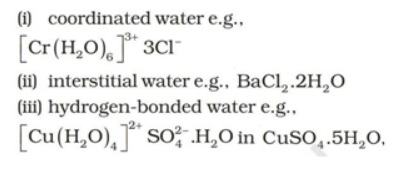
Hydrates Formation: From aqueous Solutions many salts can be crystallised as Hydrated salts. Such an association of water Is of different types viz., Coordinated water e.g.,

Hard and Soft Water- Rain water is almost pure (may contain some Dissolved gases from the atmosphere). Being a Good solvent, when it flows on the surface of The earth, it dissolves many salts. Presence of Calcium and magnesium salts in the form of Hydrogencarbonate, chloride and sulphate in Water makes water ‘hard’. Hard water does Not give lather with soap. Water free from Soluble salts of calcium and magnesium is Called Soft water. It gives lather with soap Easily. Temporary hardness is due to the presence of Magnesium and calcium hydrogen- Carbonates. It can be removed by:
Boiling: During boiling, the soluble $Mg(HCO_3)_2$ is converted into insoluble $Mg(OH)_2$ And $Ca(HCO_3)_2$ is changed to insoluble $CaCO_3$. It is because of high solubility product of $Mg(OH)_2$ as compared to that of $MgCO_3$, that $Mg(OH)_2$ is precipitated. These precipitates can Be removed by filtration. Filtrate thus obtained
Will be soft water.
$\text{Mg}(\text{HCO}_3)_2\xrightarrow{\text{Heating}}\text{Mg}(\text{OH})_2\downarrow+2\text{CO}_2\uparrow$
$\text{Ca}(\text{HCO}_3)_2\xrightarrow{\text{Heating}}\text{CaCO}_3\downarrow+\text{H}_2\text{O}+\text{CO}_2\uparrow$
Clark’s method: In this method calculated Amount of lime is added to hard water. It Precipitates out calcium carbonate and Magnesium hydroxide which can be filtered off.
Permanent Hardness is due to the presence of soluble salts of Magnesium and calcium in the form of Chlorides and sulphates in water. Permanent Hardness is not removed by boiling.
$\text{Ca}(\text{Hco}_3)_2+\text{Ca}(\text{OH)}_2\rightarrow2\text{CaCO}_3\downarrow2\text{H}_2\text{O}$
$\text{Mg}(\text{HCO)}_3+2\text{Ca}\text{(Oh)}_2\rightarrow2\text{CaCO}_3\downarrow+\text{Mg}(\text{OH)}_2\downarrow2\text{H}_2\text{O}$
Permanent Hardness is due to the presence of soluble salts of Magnesium and calcium in the form of Chlorides and sulphates in water. Permanent Hardness is not removed by boiling.
  1. In the gas phase water is a bent molecule with a bond angle of:
  1. $104.5^\circ$
  2. $94.5^\circ$
  3. $110.5^\circ$
  4. $95.5^\circ$
  1. At Atmospheric pressure ice crystallises in the … form.
  1. Cubic
  2. Hexagonal
  3. Octagonal
  4. Pentagonal
  1. Water free from Soluble salts of calcium and magnesium is called …
  1. hard water
  2. dry water
  3. soft water
  4. None of above
  1. Water has…. Nature.
  1. acidic
  2. basic
  3. neutral
  4. amphoteric
  1. Water is…. Molecule.
  1. Polar
  2. Non- Polar
  3. Ionic
  4. All the above
Read the passage given below and answer the following questions from $1$ to $5.$
Quantitative measurement of properties isreaquired for scientific investigation. Earlier, two different systems of measurement, i.e., the English System and the Metric System were being used indifferent parts of the world. The metric system, which originated in France in late eighteenth century. The SI system has seven base units. these are listed as follow.
 
Base Physical Quantities
Unit
1
Length
Metre – m
2
Mass
Kilogram – kg
3
Time
Second – s
4
Electric current
Ampere- A
5
Thermodynamic Temperature
Kelvin – K
6
Amount of substance
Mole – mol
7
Luminous intensity
Candela- cd
Here, Mass of a substance is the amount of matter present in it, while weight is the force exerted by gravity on an object. Density of a substance is its amount of mass per unit volume. The mole, symbol mol, is the SI unit of amount of substance. One mole contains exactly $6.02214076 \times 10^{23}$ elementary entities. This number is the fixed numerical value of the Avogadro constant, NA, when expressed in the unit per moland is called the Avogadro number. The amount of substance, symbol $n$, of a system is a measure of the number of specified elementary entities. An elementary entity may be an atom, a molecule, an ion, an electron, any other particle or specified group of particles.There are three common scales to measure temperature - ${ }^{\circ} C$ (degree celsius), ${ }^{\circ} F$ (degree fahrenheit) and K (kelvin). Here, K is the Slunit. Generally, the thermometer with celsius scale are calibrated from $0^{\circ}$ to $100^{\circ}$, where these two temperatures are the freezing point and the boiling point of water, respectively. The fahrenheit scale is represented between $32^{\circ}$ to $212^{\circ}$.
The temperatures on two scales are related to each other by the following relationship:
$^\circ{F} = 9 (^\circ{C}) + 32$
$5$
The kelvin scale is related to celsius scaleas follows:
$K = ^\circ{C} + 273.15$
  1. The metric system,which originated in … in late eighteenthcentury.
  1. Ukraine
  2. German
  3. Russia
  4. France
  1. The SI system has …. base units.
  1. $7$
  2. $3$
  3. $9$
  4. $1$
  1. The symbol for SI unit of thermodynamic temperature is …
  1. Kelvin
  2. $K$
  3. Degree Celsius
  4. ${}^\circ C$
  1. A prefix giga equivalents to:
  1. $10^9$
  2. $10^{10}$
  3. $10^{11}$
  4. $10^{12}$
  1. The fahrenheit scale is represented between..
  1. $0^\circ F \ to\ 100^\circ F$
  2. $32^\circ F \ to\ 212^\circ .F$
  3. $15^\circ F \ to\ 373^\circ F$

A process or change is said to be reversible, if a change is brought out in such a way that the process could, at any moment, be reversed by an infinitesimal change. A reversible process proceeds infinitely slowly by a series of equilibrium states such that system and the surroundings are always in near equilibrium with each other. Processes other than reversible processes are known as irreversible processes.
Isothermal and free expansion of an ideal gas For isothermal (T = constant) expansion of an ideal gas into vacuum; w = 0 since pex = 0. Also, Joule determined experimentally that q = 0; therefore, $\triangle\text{U}=0, \triangle =+\text{Uqw}$ can be expressed for isothermal irreversible and reversible changes as follows:
  1. For isothermal irreversible change
$\text{q}=-\text{w}=\text{nRTIn}\frac{\text{V}_\text{f}}{\text{V}_{\text{i}}}$
$=2.303\ \text{nRT}\log\frac{\text{V}_\text{f}}{\text{V}_{\text{i}}}$
  1. For isothermal reversible change
  2. For adiabatic change, q = 0
$\triangle\text{U}=\text{w}_{\text{ad}}$
In thermodynamics, a distinction is made between extensive properties and intensive properties. An extensive property is a property whose value depends on the quantity or size of matter present in the system. For example, mass, volume, internal energy, enthalpy, heat capacity, etc. are extensive properties. Those properties which do not depend on the quantity or size of matter present are known as intensive properties. For example temperature, density, pressure etc. are intensive properties. A molar property, χm, is the value of an extensive property χ of the system for 1 mol of the substance. If n is the amount of matter, χ χ m = n is independent of the amount of matter. Other examples are molar volume .
Measurement of $\triangle\text{U}$ and $\triangle{Η}$: Calorimetry We can measure energy changes associated with chemical or physical processes by an experimental technique called calorimetry. In calorimetry, the process is carried out in a vessel called calorimeter, which is immersed in a known volume of a liquid. Knowing the heat capacity of the liquid in which calorimeter is immersed and the heat capacity of calorimeter, it is possible to determine the heat evolved in the process by measuring temperature changes. Measurements are made under two different conditions: i) at constant volume, qV ii) at constant pressure, qP
Explain the determination of DeltaU of a reaction calorimetrically.
∆U Measurements For chemical reactions, heat absorbed at constant volume, is measured in a bomb calorimeter. Here, a steel vessel (the bomb) is immersed in a water bath. The whole device is called calorimeter. The steel vessel is immersed in water bath to ensure that no heat is lost to the surroundings. A combustible substance is burnt in pure dioxygen supplied in the steel bomb. Heat evolved during the reaction is transferred to the water around the bomb and its temperature is monitored. Since the bomb calorimeter is sealed, its volume does not change i.e., the energy changes associated with reactions are measured at constant volume. Under these conditions, no work is done as the reaction is carried out at constant volume in the bomb calorimeter. Even for reactions involving gases, there is no work done as $\triangle\text{v}=0$ Temperature change of the calorimeter produced by the completed reaction is then converted to qV, by using the known heat capacity of the calorimeter with the help of equation
b)$\triangle{Η}$ Measurements Measurement of heat change at constant pressure (generally under atmospheric pressure) can be done in a calorimeter shown in Figure. We know that $\triangle{Η}=\text{qp}$ (at constant p) and, therefore, heat absorbed or evolved, qP at constant pressure is also called the heat of reaction or enthalpy of reaction, $\triangle\text{rΗ}$ In an exothermic reaction, heat is evolved, and system loses heat to the surroundings. Therefore, qP will be negative and ∆rH will also be negative. Similarly in an endothermic reaction, heat is absorbed, qP is positive and $\triangle\text{rΗ}$ will be positive.
THERMODYNAMICS - NCERT Class 11 Chemistry
  1. For adiabatic change, q = 0 then …
  1. $\triangle\text{U}=\text{w}_{\text{ad}}$
  2. $\triangle\text{U}=\text{q}+\text{w}$
  3. $\triangle\text{U}=\text{w}-\text{q}$
  4. $\triangle\text{U}=\text{w}_{\text{rev}}$
  1. The technique for measure energy changes associated with chemical or physical processes by an experimental technique called …
  1. Colourimetry
  2. Calorimetry
  3. Titration
  4. Photometry
  1. A property whose value depends on the quantity or size of matter present in the system is known as …
  1. Extensive
  2. Intensive
  3. Reversible
  4. Irreversible
  1. If there is no work done …
  1. V = 0
  2. V = 1
  3. V = 2
  4. V = 3
  1. In an endothermic reaction, heat is absorbed, qP is … and $\triangle\text{rΗ}$ will be …
  1. Positive, Positive
  2. Negative, Negative
  3. Positive, Negative
  4. Negative, Positive
Read the passage given below and answer the following questions from (i) to (vi).
The atomic theory of matter was first proposed on afirm scientific basis by JohnDalton, a British schoolteacher in 1808. His theory, called Dalton’s atomictheory, regarded the atom as the ultimate particle ofmatter Dalton’s atomic theory was able to explainthe law of conservation of mass, law of constantcomposition and law of multiple proportion verysuccessfully. However, it failed to explain the results ofmany experiments.In mid 1850s many scientists mainlyFaraday began to study electrical dischargein partially evacuated tubes, known ascathode ray discharge tubes.Electrical discharge carried out in the modifiedcathode ray tube led to the discovery of canalrays carrying positively charged particles. Thecharacteristics of these positively chargedparticles are listed below.
  1. Unlike cathode rays, mass of positivelycharged particles depends upon thenature of gas present in the cathode raytube. These are simply the positivelycharged gaseous ions.
  2. The charge to mass ratio of the particlesdepends on the gas from which theseoriginate.
  3. Some of the positively charged particlescarry a multiple of the fundamental unitof electrical charge.
  4. The behaviour of these particles in themagnetic or electrical field is opposite tothat observed for electron or cathoderays.
The smallest and lightest positive ion wasobtained from hydrogen and was called
proton. This positively charged particle wascharacterised in 1919. Later, a need was feltfor the presence of electrically neutral particleas one of the constituent of atom. Theseparticles were discovered by Chadwick (1932)by bombarding a thin sheet of beryllium byα-particles. When electrically neutral particleshaving a mass slightly greater than that ofprotons were emitted. He named theseparticles as neutrons.J. J. Thomson, in 1898, proposed that an atom possesses a spherical shape (radiusapproximately 10–10 m) in which the positivecharge is uniformly distributed. The electronsare embedded into it in such a manner as togive the most stable electrostatic arrangementMany different names are given tothis model, for example, plum pudding, raisinpudding or watermelon. This model can be visualised as a pudding or watermelon ofpositive charge with plums or seeds (electrons)embedded into it. An important feature of thismodel is that the mass of the atom is assumed to be uniformly distributed over theatom.Rutherford and his students (Hans Geiger andErnest Marsden) bombarded very thin gold foilwith α–particles. Rutherford’s famous α–particle scattering experiment.The observations of Scattering experiment are as follows-:
  1. most of the α–particles passed throughthe gold foil undeflected.
  2. a small fraction of the α–particles wasdeflected by small angles.
  3. a very few α–particles (∼1 in 20,000)bounced back, that is, were deflected bynearly 180°.
On the basis of observations andconclusions from this experiment, Rutherford proposed the nuclearmodel of atom. According to this model:
  1. The positive charge and most of the massof the atom was densely concentrated inextremely small region. This very smallportion of the atom was called nucleusby Rutherford.
  2. The nucleus is surrounded by electronsthat move around the nucleus with a veryhigh speed in circular paths called orbits.Thus, Rutherford’s model of atomresembles the solar system in which thenucleus plays the role of sun and theelectrons that of revolving planets.
  3. Electrons and the nucleus are held together by electrostatic forces of attraction.
  1. The atomic theory of matter was first proposed on afirm scientific basis by:
  1. John Dalton
  2. Ernest Rutherford
  3. J.Thomson
  4. Henry Moseley
  1. The cathode rays start from … and move towards the….
  1. Anode, Cathode
  2. Centre, Anode
  3. Cathod, Anode
  4. Cathod, Centre
  1. Negativelycharged particles in atoms, called…
  1. Protons
  2. Electrons
  3. Neutron
  4. Positron
  1. The smallest and lightest positive ion wasobtained from …. and was called proton.
  1. Oxygen
  2. Nitrogen
  3. Carbon
  4. Hydrogen
  1. Electrically neutral particles having a mass slightly greater than that of protons, these particles termed as:
  1. Protons
  2. Electrons
  3. Neutron
  4. Positron
  1. J.J. Thomson’s atomic model is also named as:
  1. Plum pudding
  2. Raisin pudding
  3. Watermelon
  4. All the above