Question
The order of the differential whose general solution is given by ${\text{y}}=\text{C}_1\cos(2\text{x}+\text{C}_{2})+(\text{C}_{3}+\text{C}_{4})\text{a}^{\text{x}+\text{C}_{5}}+\text{C}_{6}\sin(\text{x}-\text{C}_{7}).$ 
  1. 3
  2. 4
  3. 5
  4. 2

Answer

  1. 5

Solution:

The given equation can be reduced to :

${\text{y}}=\text{C}_1\cos(2\text{x}+\text{C}_{2})+(\text{C}_{3}+\text{C}_{4})\text{a}^{\text{x}+\text{C}_{5}}+\text{C}_{6}\sin(\text{x}-\text{C}_{7})$

Where C = C3 + C4 be a constant

There are 5 constant (C1, C2, C3, C6, C7) in the given differential equation.

Hence, the order of the dfifferential equation is 5.

Need a full question paper?

Generate a complete, print-ready paper with questions like this in minutes — across 16+ boards, with answer keys.

Start Generating Free

Similar questions

The maximum value of $\triangle=\begin{vmatrix}1&1&1\\1&1+\sin\theta&1\\1+\cos\theta&1&1\end{vmatrix}$ is $(\theta$ is real$):$
  1. $\frac{1}{2}$
  2. $\frac{\sqrt{3}}{2}$
  3. $\sqrt{2}$
  4. $-\frac{\sqrt{3}}{2}$
A bag X contains 2 white and 3 black balls and another bag Y contains 4 white and 2 black balls. One bag is selected at random and a ball is drawn from it. Then, the probability chosen to be white is,
  1. $\frac{2}{15}$
  2. $\frac{7}{15}$
  3. $\frac{8}{15}$
  4. $\frac{14}{15}$
If the x-coordinate of a point P on the join of Q(2, 2, 1) and R(5, 1, -2) is 4, then its z-coordinate is:
  1. 2
  2. 1
  3. -1
  4. -2
If $\int_{0}^{\pi}\left(\sin ^{3} x\right) e^{-\sin ^{2} x} d x=\alpha-\frac{\beta}{e} \int_{0}^{1} \sqrt{t} e^{t} d t$, then $\alpha+\beta$ is equal to $....$
Choose the correct answer from the given four option.
Solution of $\frac{\text{d}\text{y}}{\text{d}\text{x}}-\text{y}=1,\text{ y}(0)=1$is given by:
  1. $\text{xy}=-\text{e}^\text{x}$
  2. $\text{xy}=-\text{e}^{-\text{x}}$
  3. $\text{xy}=-1$
  4. $\text{y}=2\text{e}^\text{x}-1$
Differential equation of $y = \sec ({\tan ^{ - 1}}x)$ is
let $S = \{1, 2, … 20\}$. A subset $B$ of $S$ is said to be $“nice”$, if the sum of the elements of $B$ is $203$. Then the probability that a randomly chosen subset of $S$ is $‘nice’$ is
Corner points of the bounded feasible region for an $LP$ problem are $(0,4),(6,0),(12,0),(12,16)$ and $(0,10) .$

Let $z=8 x+12 y$ be the objective function. Match the following :

$(i)$ Minimum value of $z$ occurs at $\ldots$

$(ii)$ Maximum value of $z$ occurs at $\ldots$

$(iii)$ Maximum of $z$ is $\ldots$

$(iv)$ Minimum of $z$ is $\ldots \ldots$

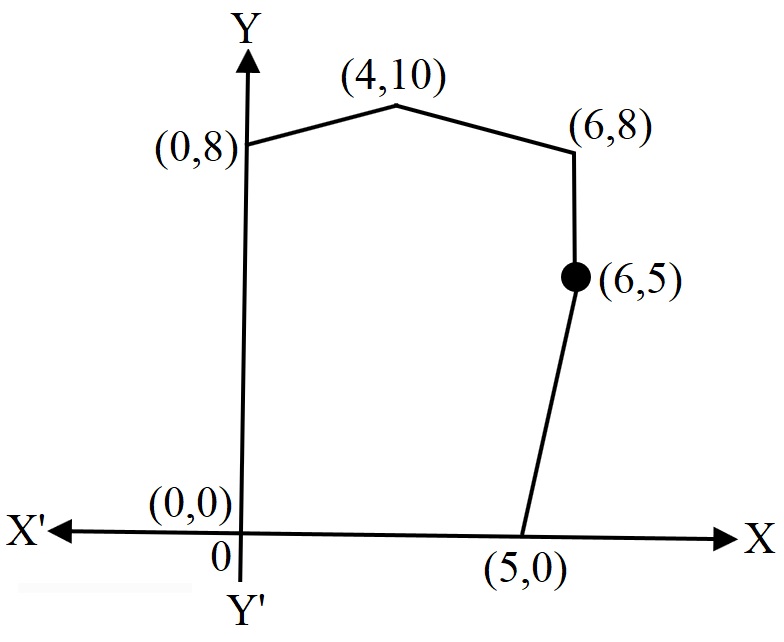
The feasible solution for a LPP is shown in the following figure. Let Z = 3x - 4y be the objective function.

Minimum of Z occurs at:

  1. (0, 0)
  2. (0, 8)
  3. (5, 0)
  4. (4, 10)
The simplest form of $\cot ^{-1}\left(\frac{1}{\sqrt{x^2-1}}\right), x>1$ is __________ .