Question
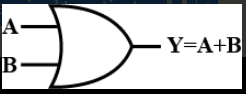
The output of OR gate is 1:

Answer

  1. If either one or both inputs are 1
Explanation:
At least one input required to activate or − gate

Need a full question paper?

Generate a complete, print-ready paper with questions like this in minutes — across 16+ boards, with answer keys.
Start Generating Free

Similar questions

The eye can detect $5 \times 10^4$ photons per square metre per $\sec$ of green light $(l = 5000 \mathring A)$ while the ear can detect $10^{-13} (W/m^2)$. The factor by which the eye is more sensitive as a power detector than the ear is close to
A big drop is formed by mixing 64 small drops. If each small drop has charge Q, then the charge on the big drop will be
Two conductors made of the same material are connected across a common potential difference. Conductor $A$ has twice the diameter and twice the length of conductor $B .$ The power delivered to the two conductors $\mathrm{P}_{\mathrm{A}}$ and $\mathrm{P}_{\mathrm{B}}$ respectively is such that $\mathrm{P}_{\mathrm{A}} / \mathrm{P}_{\mathrm{B}}$ equals to
When a current passes through a wire whose different parts are maintained at different temperatures, evolution or absorption of heat all along the length of wire is known as(a) Joule effect(b) Seebeck effect(c) Peltier effect(d) Thomson effect
       
A conducting loop is placed in a uniform magnetic field with its plane perpendicular to the field. An emf is induced in the loop if:
  1. It is translated.
  2. It is rotated about its axis.
  3. It is rotated about a diameter.
  4. It is deformed.
Consider a planet moving in an elliptical orbit round the sun. The work done on the planet by the gravitational force of the sun:
  1. Is zero in any small part of the orbit.
  2. Is zero in some parts of the orbit.
  3. Is zero in one complete revolution.
  4. Is zero in no part of the motion.
Photoelectric effect is the phenomenon in which?
A dip needle lies initially in the magnetic meridian when it shows an angle of dip $\theta$ at a place. The dip circle is rotated through an angle $x$ in the horizontal plane and then it shows an angle of dip $\theta^{\prime}.$ Then $\frac{\tan \theta^{\prime}}{\tan _{13} \theta}$
The focal lengths of the objective and eye lens of a microscope are 4 cm and 8 cm respectively, and the distance of the object from the eye lens is 4.5 cm ., then the magnifying power will be :
A sinusoidal voltage $\text{V}=200\sin314\text{t}$ is applied to a $10\Omega$ resistor. Find the peak voltage.