MCQ
The oxide, which cannot act as a reducing agent, is
  • A
    $N{O_2}$
  • B
    $S{O_2}$
  • $C{O_2}$
  • D
    $Cl{O_2}$

Answer

Correct option: C.
$C{O_2}$
c
(c) Reduction is accompanied by an increase in oxidation number of the reducing agent. $C$ belong to $IVA$ so the max - $O.N.$ is $+4$. In $C{O_2}$ the oxidation number of $C$ is $+4$, which cannot be further increased. Hence, $C{O_2}$ can not act as reducing agent.

Need a full question paper?

Generate a complete, print-ready paper with questions like this in minutes — across 16+ boards, with answer keys.
Start Generating Free

Similar questions

One litre of a gas at $STP$ weight $1.16\, g$ it can possible be
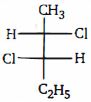
The configuration at $C-2$ and $C-3$ of the compound given
Identify the incorrect statement.
In the equation $4M + 8C{N^ - } + 2{H_2}O + {O_2} \to 4{[M{(CN)_2}]^ - } + 4O{H^ - }$ Identify the metal $M$
For the reaction, $2A + B\,\to $ products , when the concentrations of $A$ and $B$ both were doubled, the rate of the reaction increased from $0.3\,mol\,L^{-1}\,s^{-1}$ to $2.4 \,mol\,L^{-1}\,s^{-1}.$ When the concentration of $A$ alone is doubled, the rate increased from $0.3\,mol\,L^{-1}\,s^{-1}$ to $0.6\,mol\,L^{-1}\,s^{-1}.$ Which one of the following statements is correct?
Which of the following shows a metal being oxidised ?
$2.7 \mathrm{Kg}$ of each of water and acetic acid are mixed, The freezing point of the solution will be $-\mathrm{x}^{\circ} \mathrm{C}$. Consider the acetic acid does not dimerise in water, nor dissociates in water $\mathrm{x}=$ . . . . . . . (nearest integer)

[Given : Molar mass of water $=18 \mathrm{~g} \mathrm{~mol}^{-1}$, acetic acid $=60 \mathrm{~g} \mathrm{~mol}^{-1}$ ]

${ }^{\mathrm{K}_{\mathrm{f}}} \mathrm{H}_2 \mathrm{O}: 1.86 \mathrm{~K} \mathrm{~kg} \mathrm{~mol}^{-1}$

$\mathrm{K}_{\mathrm{r}}$ acetic acid : $3.90 \mathrm{~K} \mathrm{~kg} \mathrm{~mol}^{-1}$

freezing point: $\mathrm{H}_2 \mathrm{O}=273 \mathrm{~K}$, acetic acid $=290 \mathrm{~K}$ ]

The values of dissociation constants of some acids (at ${25\,^o}C$) are as follows. Indicate which is the strongest acid in water
Which of the following is correct?
Which of the following is optically active