MCQ
The pair$(s)$ of physical quantities that have the same dimensions is $($are$):$
  • A
    Volumetric strain and coefficient of friction.
  • B
    Disintegration constant of a radioactive substance and frequency of light wave.
  • Heat capacity and gravitational potential.
  • D
    Planck's constant and torque.

Answer

Correct option: C.
Heat capacity and gravitational potential.
Volumetric strain $\frac{\Delta\text{V}}{\text{V}}=\frac{\text{L}^3}{\text{L}^3}=1$
Coefficient of friction $\mu=\frac{\text{F}}{\text{R}}=\frac{\text{MLT}^{-2}}{\text{MLT}^{-2}}=1$
$\lambda=\frac{0.693}{\text{T}}=\text{T}^{-1}$
$\text{v}=\frac{1}{\text{T}}=\text{T}^{-1}$
Both have same dimensions.
Heat capacity is measured in $\text{cal/kg}$ and gravitational potential is measured in $\text{joule/ kg.}$ Both have the same dimensions $\ce{[L^2T^{-2}]}$.

Need a full question paper?

Generate a complete, print-ready paper with questions like this in minutes — across 16+ boards, with answer keys.

Start Generating Free

Similar questions

The energy spectrum of a black body exhibits a maximum around a wavelength ${\lambda _o}.$ The temperature of the black body is now changed such that the energy is maximum around a wavelength $\frac{{3{\lambda _o}}}{4}$.The power radiated by the black body will now increase by a factor of
An infinite number of masses, each of one $kg$ are placed on the $+ve\, X$ axis at $1\,m, 2\,m, 4\,m,$ origin. The magnitude of the gravitational field at origin due to this distribution of masses is :
A ball is thrown vertically up ward. It has a speed of $10\;m/sec$ when it has reached one half of its maximum height. How high ($m$ માં) does the ball rise? (Take $g = 10 \;m/s^2$)
A bullet moving with a uniform velocity v, stops suddenly after hitting the target and the whole mass melts be $m$, specific heat $S,$ initial temperature $25°C$ melting point $ 475°C$ and the latent heat $L.$ Then $v$ is given by
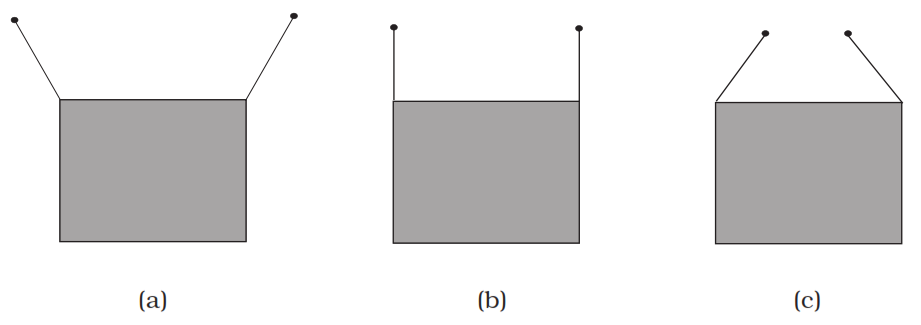
A rectangular frame is to be suspended symmetrically by two strings of equal length on two supports. It can be done in one of the following three ways;

The tension in the strings will be
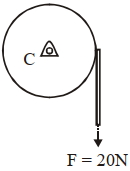
Consider a $20\, kg$ uniform circular disk of radius $0.2\, m$. It is pin supported at its center and is at rest initially. The disk is acted upon by a constant force $F =20\, N$ through a massless string wrapped around its periphery as shown in the figure.

Suppose the disk makes n number of revolutions to attain an angular speed of $50\, rad s ^{-1} .$ The value of $n$, to the nearest integer, is.......... [Given : In one complete revolution, the disk rotates by $6.28\, rad$ ]

A particle is moving in a circular path. The acceleration and momentum of the particle at a certain moment are $\vec a = (4\hat i + 3\hat j)\ m/s^2$ and $\vec p = (8\hat i - 6\hat j)\ kg-m/s$ . The motion of the particle is
Two tanks $A$ and $B$ contain water at $30\,^oC$ and $80\,^oC$ respectively. Calculate the amount of water that must be taken from each tank to prepare $40\,kg$ water at $50\,^oC$
Two constant forces ${F_1} = 2\hat i - 3\hat j + 3\hat k\,$($N$) and ${F_2} = \hat i + \hat j - 2\hat k\,$($N$) act on a body and displace it from the position ${r_1} = \hat i + 2\hat j - 2\hat k\,$($m$) to the position ${r_2} = 7\hat i + 10\hat j + 5\hat k\,$($m$). What is the work done......... $J$
A longitudinal wave is represented by $x =10 \sin 2 \pi\left( nt -\frac{ x }{\lambda}\right) \,cm$. The maximum particle velocity will be four times the wave velocity if the determined value of wavelength is equal to .....................