Question
The parallel sides of a trapezium are $20\ cm$ and $10\ cm.$ Its nonparallel sides are both equal, each being $13\ cm.$ Find the area of the trapezium.
Answer

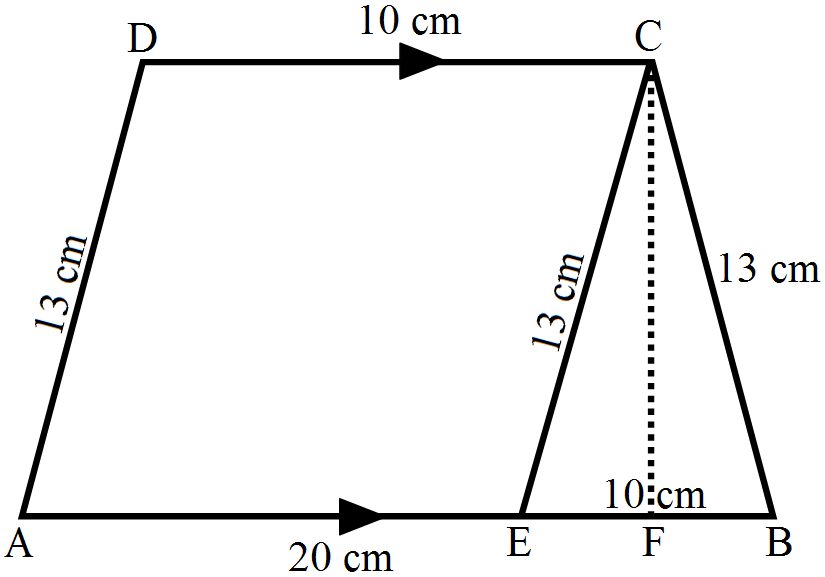
In trapezium $ABCD,$

$AB || DC$ and $AD = BC $
$AB = 20\ cm, CD = 10\ cm.$
$AD = BC = 13\ cm,$
Through $C$, draw $CE || DA$ and $\text{CF}\perp\text{EB}$ or $AB,$
Then $CE = CA = 13\ cm.$
$ EB = AB - AE = AB - CD = 20 - 10 = 10\ cm.$
Now side of $\triangle\text{ECB}$ are $13, 13, 10\ cm,$
$\text{s}=\frac{13+13+10}{2}=\frac{36}{2}=18$
$\therefore$ area of $\triangle\text{ECB},$
$=\sqrt{\text{s}(\text{s}-\text{a})(\text{s}-\text{b})(\text{s}-\text{c})}$ (Hero's formula)
$=\sqrt{18(18-13)(18-13)(18-10)}$
$=\sqrt{18\times5\times5\times8}=\sqrt{3600}=60\text{cm}^2$
But area of $\triangle\text{CEB}=\frac{1}{2}\times\text{EB}\times\text{CF}$
$\Rightarrow60=\frac{1}{2}\times10\times\text{CF}$
$\Rightarrow\text{CF}=\frac{60\times2}{10}=12\text{cm}.$
$\therefore$ Distance between two parallel lines $(h) = 12\ cm.$
$\therefore$ Area of trapezium $=\frac{1}{2}\text{h}(\text{l}_1+\text{l}_2)$
$=\frac{1}{2}\times12(20+10)\text{cm}^2$
$=6\times30=180\text{cm}^2$

Need a full question paper?

Generate a complete, print-ready paper with questions like this in minutes — across 16+ boards, with answer keys.
Start Generating Free

Similar questions

Observe the following pattern,
$ 2^2-1^2=2+1 $
$ 3^2-2^2=3+2 $
$ 4^2-3^2=4+3 $
$ 5^2-4^2=5+4 $
and find the value of,
$i. 100^2- 99^2$
$ii. 111^2- 109^2$
$iii. 99^2- 96^2$
The perimeter of a rhombus is $180\ cm$ and one of its diagonals is $72\ cm$. Find the length of the other diagonal and the area of the rhombus.
Express product as a monomials and verify the result in each case for $ x = 1: \left(x^2\right)^3 \times(2 x) \times(-4 x) \times(5) $
Find ten rational numbers between $\frac{3}{5}$ and $\frac{3}{4}.$
If principal $= Rs. 1,00,000$. rate of interest $= 10\%$ compounded half yearly. Find
$a.$ Interest for $6$ months.
$b.$ Amount after $6$ months.
$c.$ Interest for next $6$ months.
$d.$ Amount after one year.
An insect is on the $0$ point of a number line, hopping towards $1$. She covers half the distance from her current location to $1$ with each hop. So, she will be at $\frac{1}{2}$ after one hop, $\frac{3}{4}$ after two hops, and so on.
$a.$ Make a table showing the insect’s location for the first $10$ hops.
$b.$ Where will the insect be after $n$ hops?
$c.$ Will the insect ever get to $1$? Explain.
Construct a histogram for the following data:
Monthly school fee (in Rs.)
$30-60$
$60-90$
$90-120$
$120-150$
$150-180$
$180-210$
$210-240$
Number of schools
$5$
$12$
$14$
$18$
$10$
$9$
$4$
Sarita buys goods worth $Rs. 5,500$. She gets a rebate of $5\%$ on it. After getting the rebate if $VAT$ at the rate of $5\%$ is charged, find the amount she will have to pay for the goods.
Diagonals of a parallelogram $ABCD$ intersect at $O$. $AL$ and $CM$ are drawn perpendiculars to $BD$ such that $L$ and $M$ lie on $BD$. Is $AL = CM$? Why or why not?
The following table shows the expenditure incurred by a publisher in publishing a book:
Items
Paper
Printing
Binding
Advertising
Miscellaneous
Expenditure (in %)
$35\%$
$20\%$
$10\%$
$5\%$
$30\%$
Present the above data in the form of a pie-chart.