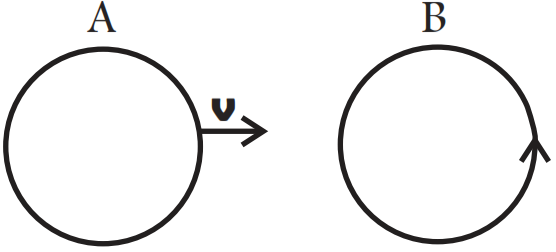
MCQ
The particle that possesses half integral spin is:
- APhoton
- BPion
- CProton
- DK-meson
Explanation:
The proton, neutron, and electron possess half-integer spin states
Generate a complete, print-ready paper with questions like this in minutes — across 16+ boards, with answer keys.
ABC is a right angled triangle in which AB = 3 cm and BC = 4 cm. And Ð ABC = p/2. The three charges +15, +12 and -20 e.s.u. are placed respectively on A, B and C. The force acting on B is
|
(a) 125 dynes |
(b) 35 dynes |
(c) 25 dynes |
(d) Zero |
Diode is used as a/an
|
(a) Oscillator |
(b) Amplifier |
(c) Rectifier |
(d) Modulator |
In an interference experiment, the spacing between successive maxima or minima is (Where the symbols have their usual meanings)
|
(a) |
(b) |
(c) |
(d) |
The refractive indices of water and glass with respect to air are 1.2 and 1.5 respectively. The refractive index of glass with respect to water is
|
(a) 0.6 |
(b) 0.8 |
(c) 1.25 |
(d) 1.75 |
A double star is a system of two stars rotating about their centre of mass only under their mutual gravitational attraction. Let the star have mass m and 2m and their separation be l. Their time period of rotation about their centre of mass will be proportional to
|
(a) |
(b) l |
(c) |
(d) |