MCQ
The passage of current liberates ${H_2}$ at cathode and $C{l_2}$ at anode. The solution is
- ACopper chloride in water
- ✓$NaCl$ in water
- C${H_2}S{O_4}$
- DWater
Cathode: ${H_2}O + {e^ - } \to \frac{1}{2}{H_2} + O{H^ - }$
Anode: $C{l^ - } \to \frac{1}{2}C{l_2} + {e^ - }$.
Generate a complete, print-ready paper with questions like this in minutes — across 16+ boards, with answer keys.
$(I)$ $\begin{array}{*{20}{c}}
{C{H_2} - C{H_2} - C{H_2} - C{H_2}OH} \\
{|\,\,\,\,\,\,\,\,\,\,\,\,\,\,\,\,\,\,\,\,\,\,\,\,\,\,\,\,\,\,\,\,\,\,\,\,\,\,\,\,\,\,\,\,\,\,\,\,\,\,\,\,\,\,} \\
{N{O_2}\,\,\,\,\,\,\,\,\,\,\,\,\,\,\,\,\,\,\,\,\,\,\,\,\,\,\,\,\,\,\,\,\,\,\,\,\,\,\,\,\,\,\,\,\,\,\,\,\,}
\end{array}$
$(II)$ $\begin{array}{*{20}{c}}
{C{H_3} - C{H_2} - CH - C{H_2}OH} \\
{|\,} \\
{N{O_2}}
\end{array}$
$(III)$ $\begin{array}{*{20}{c}}
{C{H_3} - CH - C{H_2} - C{H_2}OH} \\
{|\,\,\,\,\,\,\,\,\,\,\,\,\,\,\,\,\,\,\,\,\,\,\,\,\,\,\,} \\
{N{O_2}\,\,\,\,\,\,\,\,\,\,\,\,\,\,\,\,\,\,\,\,\,\,\,}
\end{array}$
$(IV)$ $CH_3-CH_2-CH_2-CH_2OH$
Select answer from codes given below :
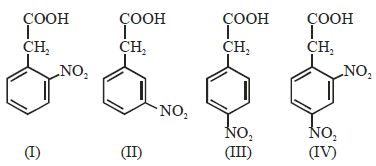
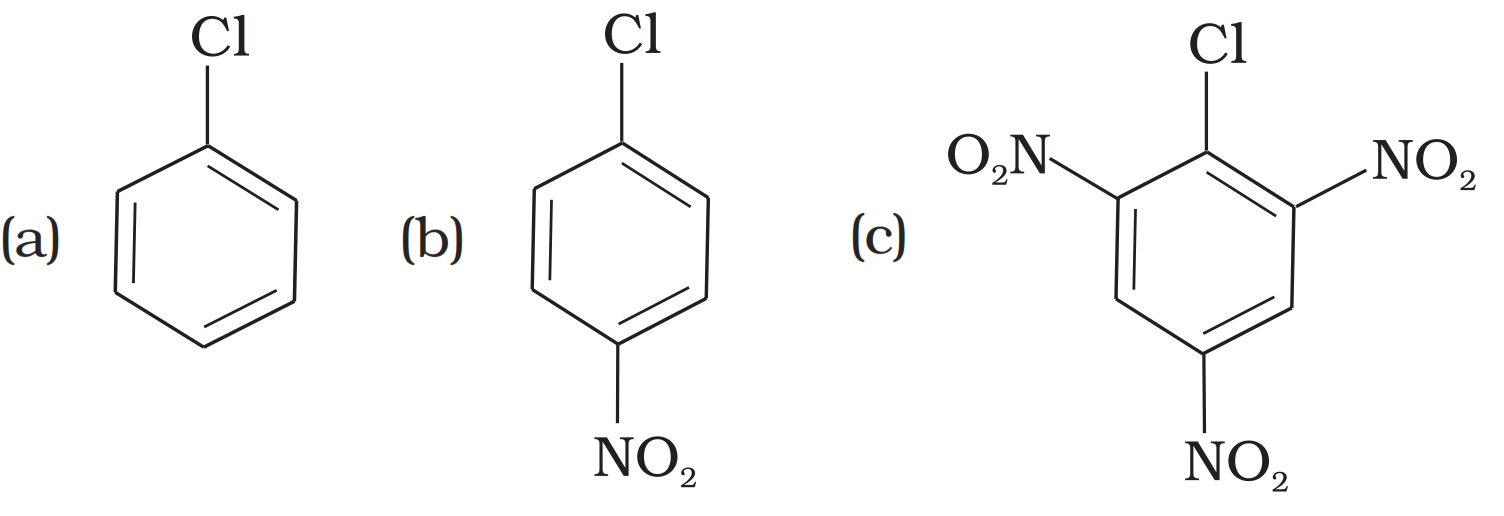
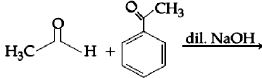
$C_2H_4O(g) \longrightarrow CH_4(g) + CO(g)$ If the initial pressure of $C_2H_4O(g)$ is $80\, mm$ and total pressure at the end of $20\, minutes$ is $120\, mm$ ............ $\min$
(molar mass of heptane $= 100\, g\, mol^{-1}$ and of octane $= 114\, g\,mol^{-1}$)