MCQ
The path of an electron in a uniform magnetic field may be:
  • A
    Circular but not helical
  • B
    Helical but not circular
  • C
    Neither helical nor circular
  • Either helical or circular

Answer

Correct option: D.
Either helical or circular

The path an electron in a uniform magnetic field my be either helical or circular.

Need a full question paper?

Generate a complete, print-ready paper with questions like this in minutes — across 16+ boards, with answer keys.

Start Generating Free

Similar questions

A silver and a copper voltmeters are connected in parallel across a 6 volt battery of negligible resistance. In half an hour, 1 gm of copper and 2 gm of silver are deposited. The rate at which energy is supplied by the battery will approximately be (Given E.C.E. of copper = $3.294\times 10^{-4}$g/C  and E.C.E. of silver = $1.118 \times 10^{-3}$g/C
The wavelength associated with an electron accelerated through a potential difference of $100 V$ is nearly .............. $\mathop {\rm{A}}\limits^o $
What will be the angular momentum of a electron, if energy of this electron in $H-$atom is $1.5\,eV$ (in $J-sec$)
Three charges each of magnitude $q$ are placed at the corners of an equilateral triangle, the electrostatic force on the charge placed at the center is (each side of triangle is $L$)
A telescope of diameter $2m$ uses light of wavelength $5000 Å$ for viewing stars. The minimum angular separation between two stars whose image is just resolved by this telescope is
Electric field of plane electromagnetic wave propagating through a non-magnetic medium is given by ${E}=20 \cos \left(2 \times 10^{10} {t}-200 {x}\right) \,{V} / {m} .$ The dielectric constant of the medium is equal to :

(Take $\mu_{{r}}=1$ )

From the following, what charges can be present on oil drops in Millikan's experiment (Here e is the electronic charge)
 
A light ray incident normally on one face of an equilateral prism and emerges out grazingly at the other face. The refractive index of the prism is
Two identical moving coil galvanometer have $10 \Omega$ resistance and full scale deflection at $2 \mu A$ current. One of them is converted into a voltmeter of $100 mV$ full scale reading and the other into an Ammeter of $1 mA$ full scale current using appropriate resistors. These are then used to measure the voltage and current in the Ohm's law experiment with $R =1000 \Omega$ resistor by using an ideal cell. Which of the following statement( $s$ ) is/are correct?

$(1)$ The measured value of $R$ will be $978 \Omega$

$(2)$ The resistance of the Voltmeter will be $100 k \Omega$.

$(3)$ The resistance of the Ammeter will be $0.02 \Omega$ (round off to $2^{\text {nd }}$ decimal place)

$(4)$ If the ideal cell is replaced by a cell having internal resistance of $5 \Omega$ then the measured value of $R$ will be more than $1000 \Omega$.
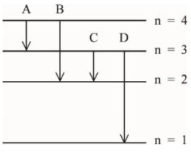
The energy levels of an hydrogen atom are shown below. The transition corresponding to emission of shortest wavelength is