MCQ
The phase difference between two points separated by $\mathrm{Im}$ in a wave of frequency $120 \mathrm{~Hz}$ is $90^{\circ}$. The wave velocity is
  • A
    $180 \mathrm{~m} / \mathrm{s}$
  • B
    $240 \mathrm{~m} / \mathrm{s}$
  • $480 \mathrm{~m} / \mathrm{s}$
  • D
    $720 \mathrm{~m} / \mathrm{s}$

Answer

Correct option: C.
$480 \mathrm{~m} / \mathrm{s}$
Path difference $\Delta=\frac{\lambda}{2 \pi} \times \phi \Rightarrow 1=\frac{\lambda}{2 \pi} \times \frac{\pi}{2}$
$ \Rightarrow \lambda=4 m$ Hence $v=n \lambda=120 \times 4=480\mathrm{~m} / \mathrm{s}$

Need a full question paper?

Generate a complete, print-ready paper with questions like this in minutes — across 16+ boards, with answer keys.

Start Generating Free

Similar questions

A sky wave with a frequency $55\ \mathrm{MHz}$ is incident on $D$-region of earth's atmosphere at $45.$ The angle of refraction is (electron density for $D$-region is $400$ electron/ $\mathrm{cm}$ )
In an isothermal expansion
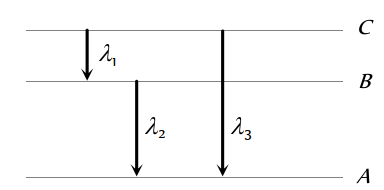
Energy levels $A, B, C$ of a certain atom corresponding to increasing values of energy i.e. $E_A<E_B<E_C$. If $\lambda_1, \lambda_2, \lambda_3$ are the wavelengths of radiations corresponding to the transitions $C$ to $B, B$ to $A$ and $C$ to $A$ respectively, which of the following statements is correct
Image
The emitter-base junction of a transistor is biased while the collector-base junction is biased
A stone falls from a balloon that is descending at a uniform rate of $12 m / s$. The displacement of the stone from the point of release after $10 sec$ is
Positive rays consists of
The period of moon's rotation around the earth is nearly $29$ days. If moon's mass were $2$ fold, its present value and all other things remained unchanged, the period of moon's rotation would be nearly
In the following atoms and moleculates for the transition from $n=2$ to $n=1$, the spectral line of minimum wavelength will be produced by
A polaroid is placed at $45$ to an incoming light of intensity $I_0$. Now the intensity of light passing through polaroid after polarisation would be
A body of mass $2 kg$ moving on a horizontal surface with an initial velocity of $4 m / sec$ comes to rest after $2 sec$. If one wants to keep this body moving on the same surface with a velocity of $4 m / sec$, the force required is