MCQ
The phenomenon utilised in an optical fibre is
  • A
    Refraction
  • B
    Interference
  • C
    Polarization
  • Total internal reflection

Answer

Correct option: D.
Total internal reflection

Need a full question paper?

Generate a complete, print-ready paper with questions like this in minutes — across 16+ boards, with answer keys.

Start Generating Free

Similar questions

The coefficient of self inductance and the coefficient of mutual inductance have.
A $p-n$ junction diode cannot be used:
If the refractive indices of crown glass for red, yellow and violet colours are respectively ${\mu _{r\,}},\,\,{\mu _y}$ and ${\mu _v}$, then the dispersive power of this glass would be
Match the following

Currents                                     $r.m.s.$ values

(1)${x_0}\sin \omega \,t$                               (i)$ x_0$

(2)${x_0}\sin \omega \,t\cos \omega \,t$                  (ii)$\frac{{{x_0}}}{{\sqrt 2 }}$

(3)${x_0}\sin \omega \,t + {x_0}\cos \omega \,t$        (iii) $\frac{{{x_0}}}{{(2\sqrt 2 )}}$
A double convex lens of focal length 20 cm is made of glass of refractive index 3 / 2. When placed completely in water ($\mu_{ w }=4 / 3)$, its focal length will be
The capacity of an air condenser is 2.0 mF. If a medium is placed between its plates. The capacity becomes 12 mF. The dielectric constant of the medium will be
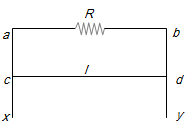
A wire cd of length l and mass m is sliding without friction on conducting rails ax and by as shown. The vertical rails are connected to each other with a resistance R between a and b. A uniform magnetic field B is applied perpendicular to the plane abcd such that cd moves with a constant velocity of
In positive logic, the logic state $1$ corresponds to:
Two identical charged spheres are suspended by strings of equal lengths. The strings make an angle $\theta$ with each other. When suspended in water the angle remains the same. If density of the material of the sphere is $1.5 \mathrm{~g} / \mathrm{cc}$, the dielectric constant of water will be

(Take density of water $=1 \mathrm{~g} / \mathrm{cc}$ )

Two point charges (+Q) and (-2Q) are fixed on the X-axis at positions a and 2a from origin respectively. At what positions on the axis, the resultant electric field is zero