Question
The physical quantity that has the same dimensional formula as pressure is :

Answer

$Y =\frac{\text { stress }}{\text { strain }} \text { (Strain is dimensionless) }$

$\therefore[ Y ]=[\text { stress }]=[\text { Pressure }]$

Need a full question paper?

Generate a complete, print-ready paper with questions like this in minutes — across 16+ boards, with answer keys.
Start Generating Free

Similar questions

A stretched string resonates with tuning fork frequency $512\; Hz$ when length of the string is $0.5\; m$. The length of the string required to vibrate resonantly with a tuning fork of frequency $256 \;Hz$ would be .......... $m$
Choose the correct statement(s) for hydrogen and deuterium atoms (considering motion of nucleus)
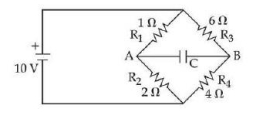
The charge accumulated on the capacitor connected in the following circuit is________ $\mu \mathrm{C}$ (Given $\mathrm{C}=150\  \mu \mathrm{F}$ )
A student uses a simple pendulum of exactly $1 \mathrm{~m}$ length to determine $\mathrm{g}$, the acceleration due to gravity. He uses a stop watch with the least count of $1 \mathrm{sec}$ for this and records $40$ seconds for $20$ oscillations. For this observation, which of the following statement$(s)$ is (are) true?

$(A)$ Error $\Delta T$ in measuring $T$, the time period, is $0.05$ seconds

$(B)$ Error $\Delta \mathrm{T}$ in measuring $\mathrm{T}$, the time period, is $1$ second

$(C)$ Percentage error in the determination of $g$ is $5 \%$

$(D)$ Percentage error in the determination of $g$ is $2.5 \%$

The equation of state for a gas is given by $PV = nRT + \alpha V$, where $n$ is the number of moles and $\alpha $ is a positive constant. The initial temperature and pressure of one mole of the gas contained in a cylinder are $T_o$ and $P_o$ respectively. The work done by the gas when its temperature doubles isobarically will be
Three large identical plates are kept parallel to each other. The outer two plates are maintained at temperatures $T$ and $2 T$, respectively. The temperature of the middle plate in steady state will be close to ........... $T$
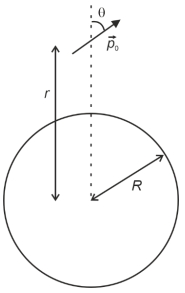
A small electric dipole $\vec{p}_0$, having a moment of inertia I about its center, is kept at a distance $r$ from the center of a spherical shell of radius $R$. The surface charge density $\sigma$ is uniformly distributed on the spherical shell. The dipole is initially oriented at a small angle $\theta$ as shown in the figure. While staying at a distance $r$, the dipole is free to rotate about its center.

If released from rest, then which of the following statement($s$) is (are) correct? [ $\varepsilon_0$ is the permittivity of free space.]

$(A)$ The dipole will undergo small oscillations at any finite value of $r$.

$(B)$ The dipole will undergo small oscillations at any finite value of $r>R$.

$(C)$ The dipole will undergo small oscillations with an angular frequency of $\sqrt{\frac{2 \sigma p_0}{\epsilon_0 I}}$ at $r=2 R$

$(D)$ The dipole will undergo small oscillations with an angular frequency of $\sqrt{\frac{\sigma p_0}{100 \epsilon_0 l}}$ at $r=10 R$
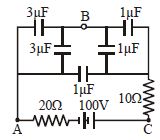
In the figure below, what is the potential difference between the points $A$ and $B$ and between $B$ and $C$ respectively in steady state
$N( < 100)$ molecules of a gas have velocities $1, 2, 3\,.\,.\,.\,.\,.N/km/s$ respectively. Then
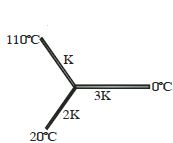
Three rods of equal length and cross sectional area and coefficient of thermal conductivities $K, 2K$ and $3K$ are joined as shown in figure temperature of their ends are $110\ ^oC, 20\ ^oC$ and $0\ ^oC$ respectively then temperature of junction will be ......... $^oC$