Question
The plate current in a diode is zero. It is possible that:

Answer

  1. The plate voltage is zero.
  2. The plate voltage is slightly negative.
  3. The plate voltage is slightly positive.
  4. The temperature of the filament is low.
Explanation:
The plate current varies directly with the plate voltage. Therefore, if the plate voltage is zero, the plate current is also zero. Due to the same reason, if the plate voltage is negative, the plate current will be zero. Now, if the plate is slightly positive, then it may be the reason that the plate voltage is not able to reduce the effect of space charge. Hence, the current may be zero. Now, as the temperature of the filament is low, it will not be able to emit electrons and the resulting plate current will be zero. Hence, all the options are possible.

Need a full question paper?

Generate a complete, print-ready paper with questions like this in minutes — across 16+ boards, with answer keys.
Start Generating Free

Similar questions

When light wave suffers reflection at the interface from air to glass, the change in phase of the reflected wave is equal to
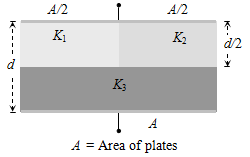
A parallel plate capacitor of area $A,$ plate separation $d$ and capacitance $C$ is filled with three different dielectric materials having dielectric constants $K_1,K_2$ and  $K_3$ as shown. If a single dielectric material is to be used to have the same capacitance $C$ in this capacitor, then its dielectric constant k is given by
An electric line of force in the $xy^−$plane is given by equation $x^{2 }+ y^{2 }= 1. A$ particle with unit positive charge, initially at rest at the point $x = 1, y = 0$ in the $xy^−$plane.
Comment on the statement given below:
In self-inductionWhen the current in a coil is increasing, induced emf opposes it
When the current in a coil is decreasing, induced emf supports it
Radius of first orbit of hydrogen atom is $0.53\ Å$, radius of fourth orbit will be :
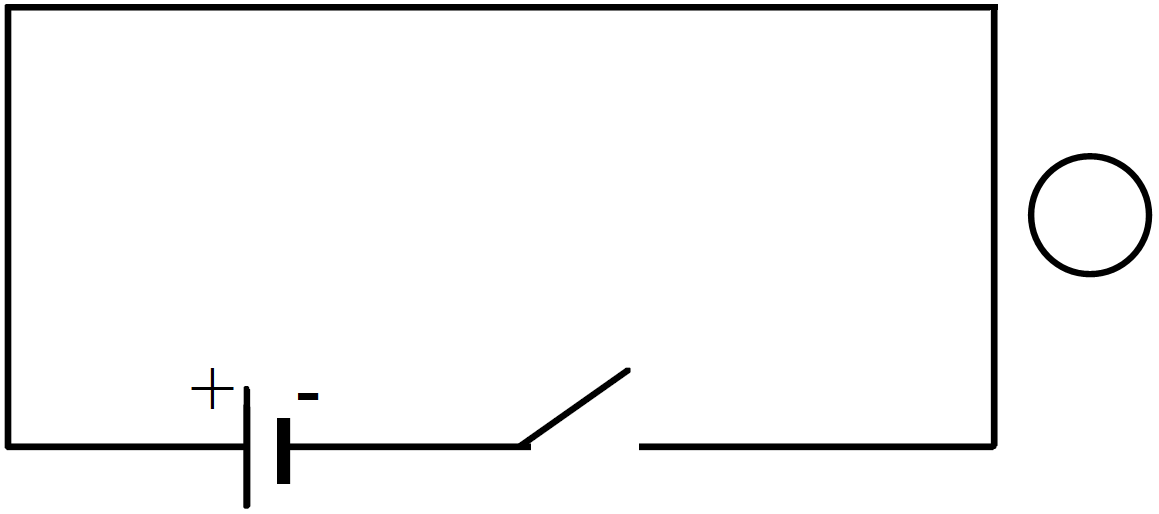
Consider the situation shown in figure. If the switch is closed and after some time it is opened again, the closed loop will show:
  1. An anticlockwise current-pulse.
  2. A clockwise current-pulse.
  3. An anticlockwise current-pulse and then a clockwise current-pulse.
  4. A clockwise current-pulse and then an anticlockwise current-pulse.
One brass plate is inserted between two charges. The force between two charges will:
Which of these is a correct definition of electronic current?
The capacity of a parallel plate condenser is 10μF  without dielectric. Dielectric of constant 2 is used to fill half the distance between the plates, the new capacitance in μF is(a) 10(b) 20(c) 15       (d) 13.33
       
Consider a capacitor$-$charging circuit. Let $Q_1$ be the charge given to the capacitor in a time interval of $10\ ms$ and $Q_2$ be the charge given in the next time interval of $10\ ms.$ Let $10\ mC$ charge be deposited in time interval $t_1$ and another $10\ mC$ charge be deposited in the next time interval $t_2.$