Question
The plate current in a triode value is maximum when the potential of the grid is:
  1. Positive.
  2. Zero.
  3. Negative.
  4. Non-positive.

Answer

  1. Positive.
Explanation:

If the grid voltage is made positive, it will help the electrons move towards the anode, which will help in increasing the current. Thus, the plate current in the triode value is maximum when the potential of the grid is positive.

Need a full question paper?

Generate a complete, print-ready paper with questions like this in minutes — across 16+ boards, with answer keys.
Start Generating Free

Similar questions

Suppose in an imaginary world the angular momentum is quantized to be even integral multiples of $\frac{\text{h}}{2\pi}$ What is the longest possible wavelength emitted by hydrogen atoms in visible range in such a world according to Bohr's model?
Read the passage given below and answer the following questions from $1$ to $5.$ The rules for determining the uncertainty or error in the measured quantity in arithmetic operations can be understood from the following examples. a.) If the length and breadth of a thin rectangular sheet are measured, using a metre scale as $16.2\ cm$ and, $10.1\ cm$ respectively, there are three significant figures in each measurement. It means that the length L may be written as L = 16.2 ± 0.1cm = 16.2cm ± 0.6%. Similarly, the breadth b may be written as $b = 10.1 ± 0.1\ cm = 10.1\ cm ± 1\%$ Then, the error of the product of two (or more) experimental values, using the combination of errors rule, will be $L*b = 163.62\ cm^2 + 1.6% = 163.62 + 2.6\ cm^2 $ This leads us to quote the final result as $L*b = 164 + 3\ cm^2.$ Here $3\ cm^2$ is the uncertainty or error in the estimation of area of rectangular sheet. b) If a set of experimental data is specified to $n$ significant figures a result obtained by combining the data will also be valid to n significant figures.However, if data are subtracted, the number of significant figures can be reduced.For example, $12.9g – 7.06g$, both specified to three significant figures, cannot properly be evaluated as 5.84g but only as $5.8g$, as uncertainties in subtraction or addition combine in a different fashion (smallest number of decimal places rather than the number of significant figures in any of the number added or subtracted). c.) The relative error of a value of number specified to significant figures depends not only on n but also on the number itself. For example, the accuracy in measurement of mass $1.02g$ is $± 0.01g$ whereas another measurement $9.89g$ is also accurate to $± 0.01g$. The relative error in $1.02g$ is: $= (± 0.01/1.02) \times 100\% = ± 1\%$ Similarly, the relative error in $9.89\ g$ is $= (± 0.01/9.89) \times 100\% = ± 0.1%$ Finally, remember that intermediate results in a multi-step computation should be calculated to one more significant figure in every measurement than the number of digits in the least precise measurement. $d.$) The nature of a physical quantity is described by its dimensions. All the physical quantities represented by derived units can be expressed in terms of some combination of seven fundamental or base quantities. We shall call these base quantities as the seven dimensions of the physical world, which are denoted with square brackets $[  ]$. Thus, length has the dimension $[L],$ mass $[M],$ time $[T],$ electric current $[A]$, thermodynamic temperature $[K]$, luminous intensity $[cd],$ and amount of substance $[mol]$. The dimensions of a physical quantity are the powers (or exponents) to which the base quantities are raised to represent that quantity. Note that using the square brackets $[ ]$ round a quantity means that we are dealing with ‘the dimensions of’ the quantity. In mechanics, all the physical quantities can be written in terms of the dimensions $[L], [M]$ and $[T]$. For example, the volume occupied by an object is expressed as the product of length, breadth and height, or three lengths. Hence the dimensions of volume are $[L] \times [L] \times [L] = [L^3].$
  1. Dimensions of area is:
  1. $[L^2]$
  2. $[L^3]$
  3. $[M^2]$
  4. None of these
  1. dimensions of volume are:
  1. $[L^2]$
  2. $[L]$
  3. $[L^3]$
  4. None of these
  1. What is uncertainty in physics$?$ Explain with one example:
  1. define dimensions of a physical quantity:
  1. Give list for $7$ base quantities with dimensions:
Read the passage given below and answer the following questions from $i$ to $v.$ we consider the motion of a projectile. An object that is in flight after being thrown or projected is called a projectile. Such a projectile might be a football, a cricket ball, a baseball or any other object. The motion of a projectile may be thought of as the result of two separate, simultaneously occurring components of motions. One component is along a horizontal direction without any acceleration and the other along the vertical direction with constant acceleration due to the force of gravity. It was Galileo who first stated this independency of the horizontal and the vertical components of projectile motion in his Dialogue on the great world systems. Horizontal range of a projectile: The horizontal distance travelled by a projectile from its initial position $(x = y = 0)$ to the position where it passes $y = 0$ during its fall is called the horizontal range, $R$. It is the distance travelled during the time of flight $T_f .$ Therefore, the range $\text{R is R} =(\text{v}_o\cos\theta_o(\text{T}_\text{f})$
$\text{R}=\frac{(\text{v}_\text{o}\cos\theta_\text{o})(2\text{v}_\text{o}\sin\theta_\text{o})}{\text{g}}$
$\text{R}=\frac{(\text{v}_\text{o}^{2}\sin\theta_\text{o})}{g}$ This shows that for a given projection velocity, $R$ is maximum when $2\theta_\text{o}$ is maximum, i.e., when $\theta_\text{o}=45^\circ.$ The maximum horizontal range is, therefore $\text{R}=\frac{\text{v}_\text{o}^2}{g}$ Maximum height of a projectile: Maximum height that can be achieved during projectile and it is given by: $\text{H}_\text{m}=\frac{\text{(v}_\text{o}\sin\theta)^2}{2g}$
  1. Range in projectile motion is maximum when $\theta^\circ:$
  1. $45^0$
  2. $0^0$
  3. $90^0$
  4. None of these
  1. Who was first stated this independency of the horizontal and the vertical components of projectile motion in his Dialogue on the great world system?
  1. Galileo
  2. Newton
  3. Einstein
  4. None of these
  1. What is projectile motion?
  1. What is horizontal range of projectile? Give its formula:
  1. What is maximum height of projectile? Give its formula:
Because to the space charge in a diode valve:
  1. The plate current decreases.
  2. The plate voltage increases.
  3. The rate of emission of thermions increases.
  4. The saturation current increases.
Calculate the amplification factor of a triode valve that has plate resistance of $2\text{k}\Omega$ and transconductance of 2 millimho.
To keep valuable instruments away from the earth's magnetic field, they are enclosed in iron boxes. Explain.
The magnetic field due to the earth has a horizontal component of $26\mu\text{T}$ at a place where the dip is 60°. Find the vertical component and the magnitude of the field.
A child has near point at 10cm. What is the maximum angular magnification the child can have with a convex lens of focal length 10cm?
A long bar magnet has a pole strength of 10A-m. Find the magnetic field at a point on the axis of the magnet at a distance of 5cm from the north pole of the magnet.
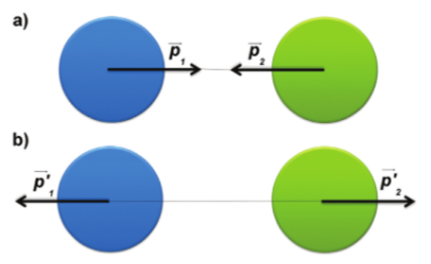
The kinetic energy of an object is the energy associated with the object which is under motion. It is defined as "the energy required by a body to accelerate from rest to stated velocity." It is a vector quantity and the momentum of an object is the virtue of its mass. It is defined as the product of mass and velocity. It is a vector quantity. The relation between them is given by $E =\frac{P^2}{2 m}$. In case of the elastic collision both of these quantities remain constant.
Image
1.Two masses of 1 gm and 4 gm are moving with equal linear momentum. The ratio of their kinetic energy is:
(a) $1: 2$ (b) $4: 1$ (c) $1: 1$ (d) $4: 2$
2. If the linear momentum is increased by $50 \%$, then K .E will be increased by:
(a) $50 \%$ (b) $200 \%$ (c) $125 \%$ (d) $100 \%$
3.A heavy object and a light object have the same momentum. Which has the greater speed?
(a) both heavy and light object
(b) heavy object
(c) Moderate object
(d) light object
OR
Kinetic energy with any reference must be $\qquad$
(a) Change (b) negative (c) zero (d) positive
4.When a body moves with a constant speed along a circle then
(a) no acceleration is produced
(b) no work is done on it
(c) no displacement on it
(d) no force acts on it