MCQ
The point representing reso- nant condition in the figure given is:
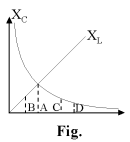
- ✓A
- BB
- CC
- DD
Generate a complete, print-ready paper with questions like this in minutes — across 16+ boards, with answer keys.
The half life of polonium is 140 days. After how many days, 16 gm polonium will be reduced to 1 gm (or 15g will decay)
|
(a) 700 days |
(b) 280 days |
(c) 560 days |
(d) 420 days |
When a point source of monochromatic light is at a distance of 0.2 m from a photoelectric cell, the cut-off voltage and the saturation current are 0.6 volt and 18 mA respectively. If the same source is placed 0.6 m away from the photoelectric cell, then
|
(a) The stopping potential will be 0.2 V |
(b) The stopping potential will be 0.6 V |
|
(c) The saturation current will be 6 mA |
(d) The saturation current will be 18 mA |
When a current is passed through water, acidified with a dilute sulphuric acid, the gases formed at the platinum electrodes are
|
(a) 1 vol. hydrogen (cathode) and 2 vol. oxygen (anode) |
|
(b) 2 vol. hydrogen (cathode) and 1 vol. oxygen (anode) |
|
(c) 1 vol. hydrogen (cathode) and 1 vol. oxygen (anode) |
|
(d) 1 vol. oxygen (cathode) and 2 vol. hydrogen (anode) |
A nucleus decays by  emission followed by a gamma emission. If the atomic and mass numbers of the parent nucleus are Z and A respectively, the corresponding numbers for the daughter nucleus are respectively.
|
(a) Z - 1 and A - 1 |
(b) Z + 1 and A |
(c) Z - 1 and A |
(d) Z + 1 and A - 1 |
Wave which cannot travel in vacuum is
|
(a) X-rays |
(b) Infrasonic |
(c) Ultraviolet |
(d) Radiowaves |