Question
The position of a particle is given by: $\vec{\text{r}}=3.0\text{t}\hat{\text{i}}-2.0\text{t}^2\hat{\text{j}}+4\hat{\text{k}}\text{ m}$ where $t$ is in seconds, $r$ is in metres and the coefficients have the proper units.
  1. Find the velocity $v$ and acceleration $a.$
  2. What is the magnitude of velocity of the particle at $t = 2s$?
Answer

$\vec{\text{r}}=3.0\text{t}\hat{\text{i}}-2.0\text{t}^2\hat{\text{j}}+4\hat{\text{k}}\text{ m}$
  1. $\vec{\text{v}}=$ velocity $=\frac{\text{d}\vec{\text{r}}}{\text{dt}}=3.0\hat{\text{i}}-4.0\text{t }\hat{\text{j }}\text{m/s}$
$\vec{\text{a}}=$ acceleration $=\frac{\text{d}\vec{\text{v}}}{\text{dt}}=-4.0\hat{\text{ j }}\text{m/s}^2$
  1. Magnitude of velocity at $t = 2s$
$\vec{\text{v}}=3.0\hat{\text{i}}-8.0\hat{\text{j}}$
$|\vec{\text{v}}|=\sqrt{(3)^2+(-8)^2}$
$=\sqrt{9+64}=\sqrt{73}\text{ m/s}$

Need a full question paper?

Generate a complete, print-ready paper with questions like this in minutes — across 16+ boards, with answer keys.

Start Generating Free

Similar questions

The magnetic field B inside a long solenoid, carrying a current of $5.00A$, is $3.14 \times 10^{-2}T$. Find the number of turns per unit length of the solenoid.
Find the temperature at which the speed of sound in oxygen will be the same as that in nitrogen at 20°C. Given that molar masses of oxygen and nitrogen are 32 and 28 respectively. Both gases are assumed to be ideal.
A black body at 2000K emits maximum energy at a wavelength of $1.56\mu\text{m}.$ At what temperature will it emit maximum energy at a wavelength of $1.8\mu\text{m}\ ?$
Suppose an attractive nuclear force acts between two protons which may be written as $\text{F}=\text{Ce}^{-\text{kr}}/\text{r}^2.$
  1. Write down the dimensional formulae and appropriate $SI$ units of $C$ and $k.$
  2. Suppose that $k = 1 \text{fermi}^{-1}$ and that the repulsive electric force between the protons is just balanced by the attractive nuclear force when the separation is $5$ fermi. Find the value of $C.$
The voltage across a lamp is $(6.0 \pm 0.1)$ volt and the current passing through it is $(4.0 \pm 0.2)$ ampere. Find the power consumed by the lamp.
A famous relation in physics relates ‘moving mass’ m to the ‘rest mass’ mo of a particle in terms of its speed v and the speed of light, c. (This relation first arose as a consequence of special relativity due to Albert Einstein). A boy recalls the relation almost correctly but forgets where to put the constant c. He writes: $\text{m}=\frac{\text{m}_0}{(1-\text{v}^2)^{1/2}}.$ Guess where to put the missing c.
A monkey of mass 40 kg climbs on a rope which can stand a maximum tension 600 N . In which of the following cases will the rope break?
The monkey
a. climbs up with an acceleration of $6 m / s ^2$
b. climbs down with an acceleration of $4 m / s ^2$
c. climbs up with a uniform speed of $5 m / s$
d. falls down the rope freely under gravity. Take $g=10 m / s ^2$ and ignore the mass of the rope.
A SONAR system fixed in a submarine operates at a frequency $40.0 kHz$ . An enemy submarine moves towards the $SONAR$ with a speed of $360 km h ^{-1}$. What is the frequency of sound reflected by the submarine? Take the speed of sound in water to be $1450 m s ^{-1}$.
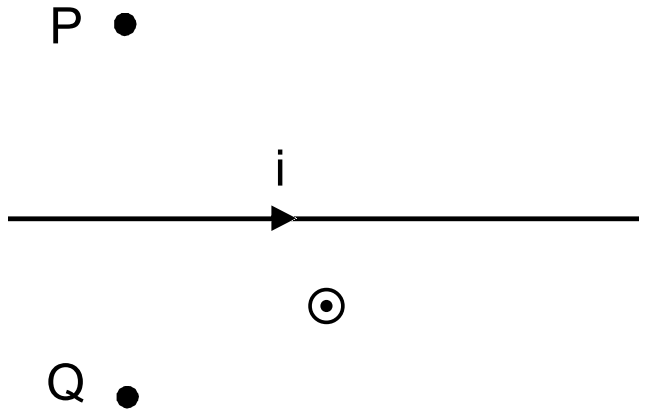
A long, straight wire carrying a current of 1.0A is placed horizontally in a uniform magnetic field B = $1.0 \times 10^{-5}T$ pointing vertically upward figure. Find the magnitude of the resultant magnetic field at the points Pand Q, both situated at a distance of 2.0cm from the wire in the same horizontal plane.
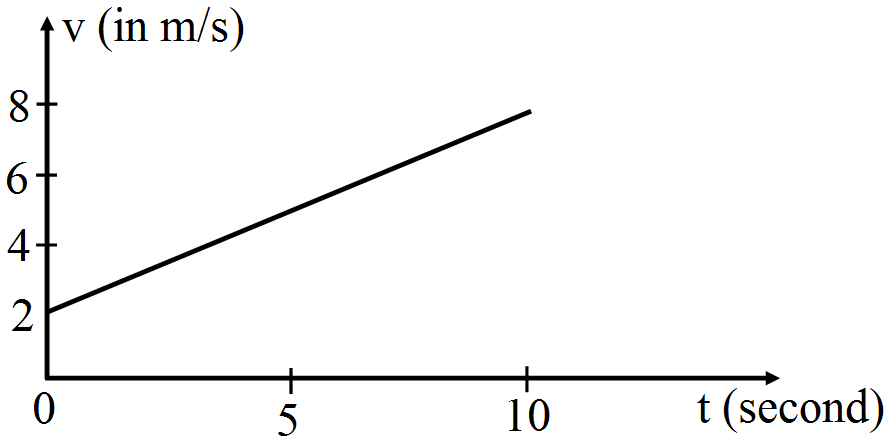
Figure shows the graph of velocity versus time for a particle going along the $X-$axis. Find:
  1. The acceleration.
  2. The distance travelled in $0$ to $10s.$
  3. The displacement in $0$ to $10s$.