Question
The position of a particle is given by $\vec{\text{r}}=9\text{t}\hat{\text{i}}+6\text{t}^2\hat{\text{j}}+8\hat{\text{k}},$ where $t$ is in seconds and the coefficients have the proper units for $\vec{\text{r}}$ to be in metres.
  1. Find velocity $\vec{\text{v}}(\text{t})$ of particle and $\vec{\text{a}}(\text{t})$ acceleration of the particle.
  2. Find the magnitude and direction of $\vec{\text{v}}(\text{t})$ at $t = 2sec.$
Answer

$\vec{\text{r}}=9\text{t}\hat{\text{i}}+6\text{t}^2\hat{\text{j}}+8\hat{\text{k}}$ $\vec{\text{v}}(\text{t})=\frac{\vec{\text{dr}}}{\text{dt}}=9\hat{\text{i}}+12\text{t}\hat{\text{j}}$ $\vec{\text{a}}(\text{t})=\frac{\vec{\text{dv}}}{\text{dt}}=12\hat{\text{j}} = 12m/ s$ along $y-$axis At $t = 2 \vec{\text{v}}=9\hat{\text{i}}+12(2)\hat{\text{j}}$
or, $\vec{\text{v}}=9\hat{\text{i}}+24\hat{\text{j}}$
magnitude, $|\vec{\text{v}}|=\sqrt{(9)^2+(24)^2}=25\text{ m/s}$ direction $\theta=\tan^{-1}\Big(\frac{25}{9}\Big)$ with $x-$axis

Need a full question paper?

Generate a complete, print-ready paper with questions like this in minutes — across 16+ boards, with answer keys.

Start Generating Free

Similar questions

A particle of mass m is projected with a speed u at an angle $\theta$ with the horizontal. Find the torque of the weight of the particle about the point of projection when the particle is at the highest point.
A constant force of 2.50N accelerates a stationary particle of mass 15g through a displacement of 2.50m. Find the work done and the average power delivered.
Two simple harmonic motions are represented by the following equations:$\text{y}_1=10\sin\frac{\pi}{4}(12\text{t}+1)$
and $\text{y}_2=5(\sin3\pi\text{t}+\sqrt{3}\cos\pi\text{t}).$ What is the ratio of their amplitudes?
A woman pushes a trunk on a railway platform which has a rough surface. She applies a force of $100 N$ over a distance of $10 m.$ Thereafter, she gets progressively tired and her applied force reduces linearly with distance to $50 N.$ The total distance through which the trunk has been moved is $20 m.$ Plot the force applied by the woman and the frictional force, which is $50 N$ versus displacement. Calculate the work done by the two forces over $20 m.$
Find moment of inertia of a thin rod about an axis perpendicular to it and passing through its mid-point.
Just as precise measurements are necessary in science, it is equally important to be able to make rough estimates of quantities using rudimentary ideas and common observations. Think of ways by which you can estimate the following (where an estimate is difficult to obtain, try to get an upper bound on the quantity): The number of air molecules in your classroom.
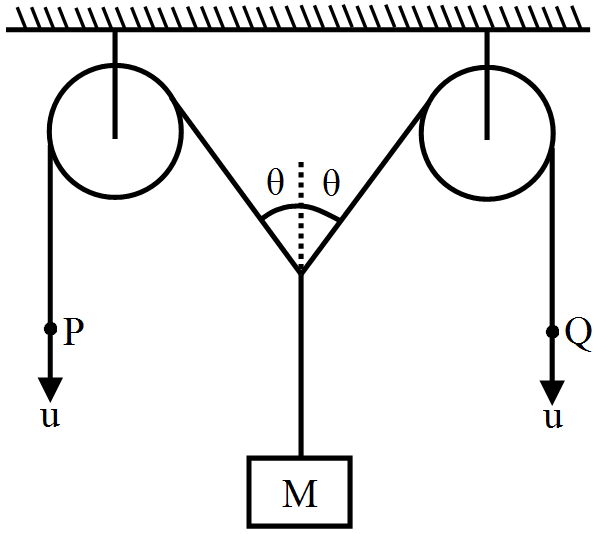
In the given arrangement, if the points P and Q move down with a velocity u, find the velocity of M?
Prove that as the object moves towards the ground from some height, its potential energy decreases and kinetic energy increases by the same amount.
Define gravitational field intensity. Which of the planet of the solar system has the greatest gravitational field intensity? What is the gravitational field intensity of a planet where the weight of $60\ kg$ astronaut is $300N$?
A copper block of mass 2.5 kg is heated in a furnace to a temperature of $500^{\circ} \mathrm{C}$ and then placed on a large ice block. What is the maximum amount of ice that can melt? (Specific heat of copper $=0.39 \mathrm{Jg}^{-1} \mathrm{~K}^{-1}$; heat of fusion of water $=335 \mathrm{~J} \mathrm{~g}^{-1}$ ).