Question
The position, velocity and acceleration of a particle executing simple harmonic motion are found to have magnitudes 2cm, 1m/s and 10m/s2 at a certain instant. Find the amplitude and the time period of the motion.

Answer

Given that, at a particular instant,

X = 2cm = 0.02m

V = 1m/sec

A = 10 m/s2

We know that $\text{a}=\omega^2\text{x}$

$\Rightarrow\omega=\sqrt{\frac{\text{a}}{\text{x}}}=\sqrt{\frac{10}{0.02}}=\sqrt{500}=10\sqrt{5}$

$\text{T}=\frac{2\pi}{\omega}=\frac{2\pi}{10\sqrt{5}}=\frac{2\times3.14}{10\times2.236}=0.28\text{ seconds.}$

Again, amplitude r is given by $\text{v}=\omega\Big(\sqrt{\text{r}^2-\text{x}^2}\Big)$

$\Rightarrow\text{v}^2=\omega^2(\text{r}^2-\text{x}^2)$

$1=500(\text{r}^2-0.0004)$

$\Rightarrow\text{r}=0.0489\approx0.049\text{m}$

$\therefore\text{r}=4.9\text{cm.}$

Need a full question paper?

Generate a complete, print-ready paper with questions like this in minutes — across 16+ boards, with answer keys.
Start Generating Free

Similar questions

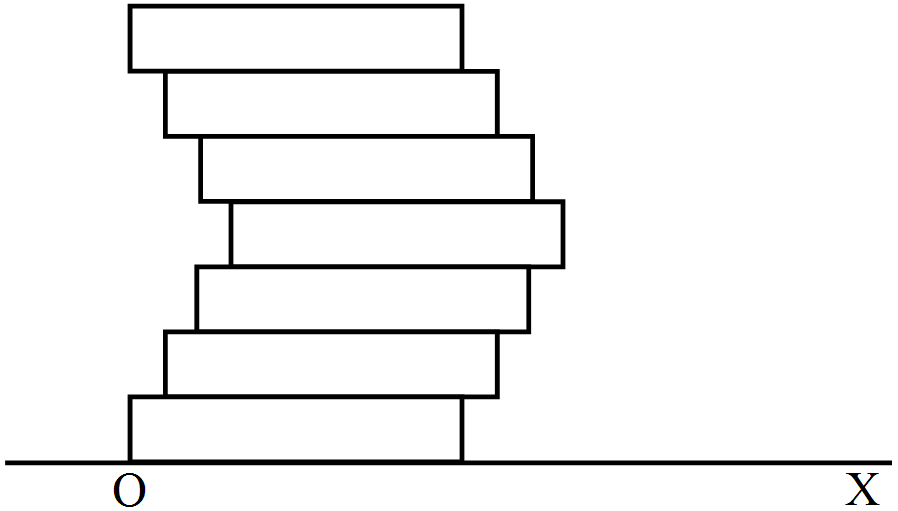
Seven homogeneous bricks, each of length L, are arranged as shown in figure. Each brick is displaced with respect to the one in contact by $\frac{\text{L}}{10}.$ Find the x-coordinate of the centre of mass relative to the origin shown.

To simulate car accidents, auto manufacturers study the collisions of moving cars with mounted springs of different spring constants. Consider a typical simulation with a car of mass $1000 kg$ moving with a speed $18.0 km / h$ on a smooth road and colliding with a horizontally mounted spring of spring constant $5.25 \times 10^3 N m ^{-1}$. What is the maximum compression of the spring?

Consider the above Example taking the coefficient of friction, µ, to be 0.5 and calculate the maximum compression of the spring.
The triple points of neon and carbon dioxide are 24.57K and 216.55K respectively. Express these temperatures on the Celsius and Fahrenheit scales.
An object of mass m is raised from the surface of the earth to a height equal to the radius of the earth, that is, taken from a distance R to 2R from the centre of the earth. What is the gain in its potential energy?
A grindstone has a moment of inertia of 6kg m2. A constant torque is applied and the grindstone is found to have a speed of 150rpm, 10s. after starting from rest. Calculate the torque.
State the kinematic equations for uniformly accelerated motion.
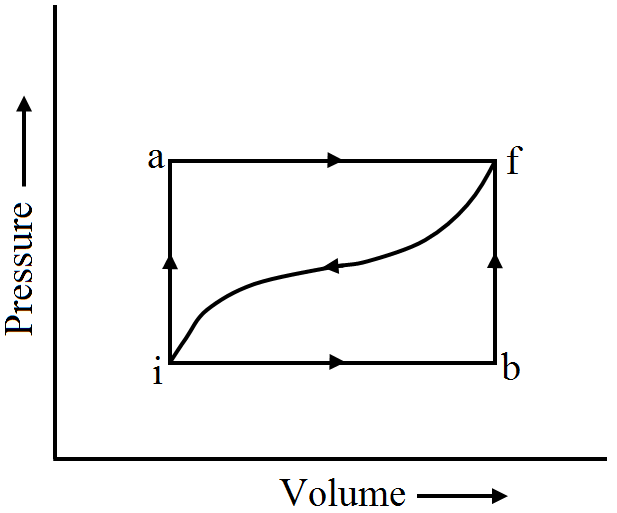
When a system is taken from state i to state f along the path iaf (see fig. below), it is found that the heat Q absorbed by the system is 50 cal. and work done W by the system is equal to 20 cal. along the path ibf; Q = 36 cal.
  1. What is W along the path ibf?
  2. If W = -13 cal. for the curved return path fi, what is for this path?
  3. Take Ui = 10 cal, what is Uf?
  4. If Ub = 22 cal. what are Q for the processes bf and ib?
​​​​​​​
Calculate the velocity of the centre of mass of the system of particles shown in figure.


An organ pipe of length L open at both ends is found to vibrate in its first harmonic when sounded with a tuning fork of 480Hz. What should be the length of a pipe closed at one end, so that it also vibrates in its first harmonic with the same tuning fork?
Suppose the particle of the previous problem has a mass m and a speed v before the collision and it sticks to the rod after the collision. The rod has a mass M:
  1. Find the velocity of the centre of mass C of the system constituting ''The rod plus the particle''.
  2. Find the velocity of the particle with respect to C before the collision.
  3. Find the velocity of the rod with respect to C before the collision.
  4. Find the angular momentum of the particle and of the rod about the centre of mass C before the collision.
  5. Find the moment of inertia of the system about the vertical axis through the centre of mass C after the collision.
  6. Find the velocity of the centre of mass C and the angular velocity of the system about the centre of mass after the collision.