Question
The position, velocity and acceleration of a particle executing simple harmonic motion are found to have magnitudes 2cm, 1m/s and 10m/s2 at a certain instant. Find the amplitude and the time period of the motion.

Answer

Given that, at a particular instant,

X = 2cm = 0.02m

V = 1m/sec

A = 10 m/s2

We know that $\text{a}=\omega^2\text{x}$

$\Rightarrow\omega=\sqrt{\frac{\text{a}}{\text{x}}}=\sqrt{\frac{10}{0.02}}=\sqrt{500}=10\sqrt{5}$

$\text{T}=\frac{2\pi}{\omega}=\frac{2\pi}{10\sqrt{5}}=\frac{2\times3.14}{10\times2.236}=0.28\text{ seconds.}$

Again, amplitude r is given by $\text{v}=\omega\Big(\sqrt{\text{r}^2-\text{x}^2}\Big)$

$\Rightarrow\text{v}^2=\omega^2(\text{r}^2-\text{x}^2)$

$1=500(\text{r}^2-0.0004)$

$\Rightarrow\text{r}=0.0489\approx0.049\text{m}$

$\therefore\text{r}=4.9\text{cm.}$

Need a full question paper?

Generate a complete, print-ready paper with questions like this in minutes — across 16+ boards, with answer keys.
Start Generating Free

Similar questions

The electric field associated with a light wave is given by $\text{E}=\text{E}_0\sin[(1.57\times10^7\text{m}^{-1})(\text{x}-{\text{ct}})].$ Find the stopping potential when this light is used in an experiment on photoelectric effect with the emitter having work function 1.9eV.
Explain graphically the flow of current in semiconductors in the presence of an external electric field.
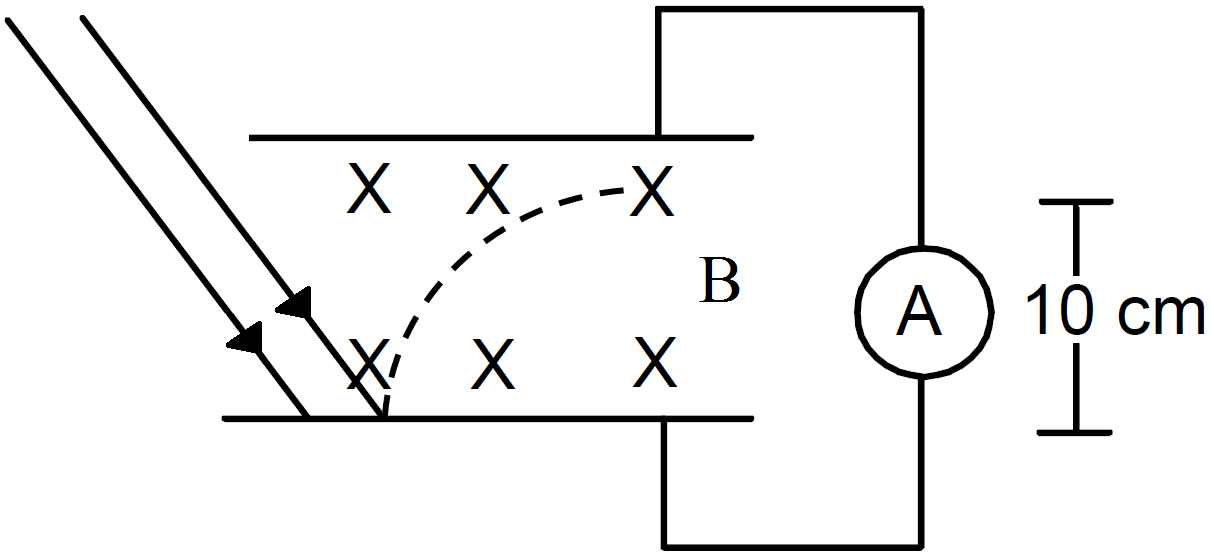
In an experiment on photoelectric effect, the emitter and the collector plates are placed et a separation of 10cm and are connected through en ammeter without any cell A magnetic field B exists parallel to the plates. The work function of the emitter is 2.39eV and the light incident on it has wavelengths between 400nm and 600nm. Find the minimum value of B for which the current registered by the ammeter is zero. Neglect any effect of space charge.

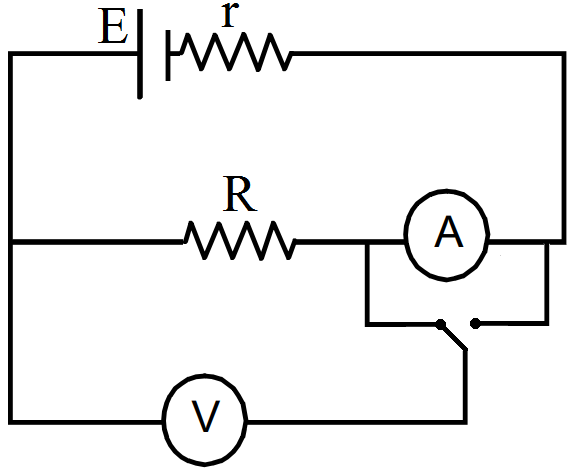
The emf $\in$ and the internal resistance r of the battery, shown in the figure. are 4.3V and $1.0\Omega$ respectively. The external resistance R is $50\Omega.$ The resistances of the ammeter and voltmeter are $2.0\Omega$ and $200\Omega$ respectively. (a) Find the readings of the two $200\Omega$ respectively. (a) Find the readings of the two meters. (b) The switch is thrown to the other side. What will be the readings of the two meters now?

By describing electromagnetic spectrum, give a description of its various parts.
Two large conducting plates are placed parallel to each other with a separation of 2.00cm between them. An electron starting from rest near one of the plates reaches the other plate in 2.00 microseconds. Find the surface charge density on the inner surfaces.
What is radioactivity? State the laws of $\alpha$-rays and $\beta$-rays.
Describe the principle and working of a cyclotron with proper diagram. Give the expression of cyclotron frequency and kinetic energy of the particle regarding cyclotron.
The left end of a copper rod (length = 20cm area of cross section = 0.20cm) is maintained at 20°C and the right end is maintained at 80°C. Neglecting any loss of heat through radiation, find,
  1. The temperature at a point 11cm from the left end
  2. The heat current through the rod. Thermal conductivity of copper $=385\text{Wm}^{-1}{^{\circ}}\text{C}^{-1}.$
An object is placed at a distance of 30cm from a converging lens of focal length 15cm. A normal eye (near point 25cm, far point infinity) is placed close to the lens on the other side.
  1.  Can the eye see the object clearly?
  2.  What should be the minimum separation between the lens and the eye so that the eye can clearly see the object?
  3.  Can a diverging lens, placed in contact with the converging lens, help in seeing the object clearly when the eye is close to the lens?