MCQ
The possible values of principal quantum number can be:
- A1, 2, 3...8
- B0, 1, 2...8
- Conly zero
- Donly odd numbers
Explanation:
Values of Principle quantum number are 1, 2, 3, 4.....8. 0 is not a Principle quantum number.
Only odd numbers are not Principle quantum numbers either.
Odd numbers, as well as even numbers, are Principle quantum number except 0 and negative integers.
Generate a complete, print-ready paper with questions like this in minutes — across 16+ boards, with answer keys.
Which of the following statements is true for an N-type semi-conductor
|
(a) The donor level lies closely below the bottom of the conduction band |
|
(b) The donor level lies closely above the top of the valence band |
|
(c) The donor level lies at the halfway mark of the forbidden energy gap |
|
(d) None of above |
A thermocouple is made of Cu and Fe. If a battery is connected in it, then
|
(a) Both junctions will be at the same temperature |
|
(b) Both junctions will become hot |
|
(c) One junction will be hotter than the other |
|
(d) None of these |
The apparent wavelength of the light from a star moving away from the earth is 0.01% more than its real wavelength. Then the velocity of star is
|
(a) 60 km/sec |
(b) 15 km/sec |
(c) 150 km/sec |
(d) 30 km/sec |
When the reflecting or refracting rays do not actually intersect but appear to intersect when produced backwards,
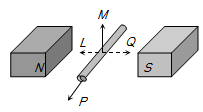
An electric potential difference will be induced between the ends of the conductor shown in the diagram, when the conductor moves in the direction
|
(a) P |
(b) Q |
(c) L |
(d) M |
The number of wavelengths in the visible spectrum
|
(a) 4000 |
(b) 6000 |
(c) 2000 |
(d) Infinite |
A convex lens of focal length 25 cm and a concave lens of focal length 10 cm are joined together. The power of the combination will be
|
(a) – 16 D |
(b) + 16 D |
(c) – 6 D |
(d) + 6 D |