MCQ
The potential difference between the plates of a parallel plate capacitor is changing at the rate of $10^6\, V/s$. If the capacitance is $2\,\mu F$, the displacement current in the dielectric of the capacitor will be.....$A$
  • A
    $1$
  • $2$
  • C
    $3$
  • D
    $4$

Answer

Correct option: B.
$2$
b
Displacement current is given by

$\mathrm{i}_{\mathrm{d}}=\varepsilon_{0} \frac{\partial \phi_{\mathrm{E}}}{\partial \mathrm{t}}$

where $\phi_{\mathrm{E}}$ is the electric flux given as $\phi_{\mathrm{E}}=\mathrm{EA}$ where $A$ is area of the capacitor plates and $E$ is the electric field between the plates.

So,  $\mathrm{i}_{\mathrm{d}}=\varepsilon_{0} \frac{\partial(\mathrm{EA})}{\partial \mathrm{t}}=\varepsilon_{0} \mathrm{A} \frac{\partial \mathrm{E}}{\partial \mathrm{t}}$

But $\mathrm{E}=\mathrm{V} / \mathrm{d}$ where $\mathrm{V}$ is the potential difference between the capacitor plates separated at $d$ distant apart.

So, $i_{d}=\frac{\varepsilon_{0} A}{d} \frac{\partial V}{\partial t}=C \frac{\partial V}{\partial t}$

where $\mathrm{C}$ is the capacity of the capacitor.

$\therefore $ $\mathrm{i}_{\mathrm{d}}=2 \times 10^{-6} \times 10^{6}=2 \mathrm{A}$
Need a full question paper?

Generate a complete, print-ready paper with questions like this in minutes — across 16+ boards, with answer keys.

Start Generating Free

Similar questions

An electron moving in a circular orbit of radius $r$ makes $n$ rotation per second. The magnetic field produced at the centre has a magnitude of
A person carrying a whistle emitting continuously a note of $272 Hz$ is running towards a reflecting surface with a speed of $18\, km/hour. $ The speed of sound in air is $345m{s^{ - 1}}$. The number of beats heard by him is
A wooden block floats in a liquid with $40\%$ of its volume inside the liquid. When the vessel containing he liquid starts rising upwards with acceleration $a = g/2$, the percentage of volume inside the liquid is ......... $\%$
The main scale of a vernier calliper has $n$ divisions/ $\mathrm{cm}$. $n$ divisions of the vernler scale coincide with $(\mathrm{n}-1)$ divisions of maln scale. The least count of the vernler calliper is,
The radius of curvature of convex surface of a thin plano-convex lens is $15 cm$ and refractive index of its material is $1.6.$ The power of the lens will be
A person walks up a stalled escalator in $90 s$. When just standing on the same moving escalator, he is carried in $60 s$. The time it would take him to walk up the moving escalator will be $.......\,s$
If a body describes a circular motion under inverse square field, the time taken to complete one revolution $T$ is related to the radius of the circular orbit as
A particle of mass $4\, {M}$ at rest disintegrates into two particles of mass ${M}$ and $3 \,{M}$ respectively having non zero velocities. The ratio of de-Broglie wavelength of particle of mass $M$ to that of mass $3\, {M}$ will be :
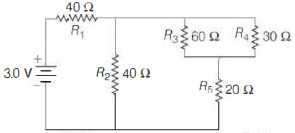
In the circuit shown below, the resistances are given (in $\Omega$ ) and the battery is assumed ideal with emf equal to $3.0 \,V$. The resistor that dissipates the most power is
Consider the following statements regarding the real images formed with a converging lens.

$I$. Real images can be seen only if the image is projected onto the screen.

$II$. The real image can be seen only from the same side of the lens as that on which the object is positioned.

$III$. Real images produced by converging lenses are not only laterally but also longitudinally inverted as with mirrors.

Which of the above statement(s) is/are incorrect?