Question
The potential difference between the terminals of a 6.0V battery is 7.2V when it is being charged by a current of 2.0A. What is the internal resistance of the battery?
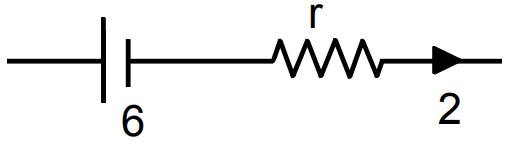
Answer


$\text{V}=\in+\text{ir}$

$\Rightarrow7.2=6+2\times\text{r}$

$\Rightarrow1.2=2\text{r}\Rightarrow\text{r}=0.6\Omega.$

Need a full question paper?

Generate a complete, print-ready paper with questions like this in minutes — across 16+ boards, with answer keys.

Start Generating Free

Similar questions

Two capacitors of capacitance $3 \mu F$ and 4 $\mu F$ are charged separately from a 6 V battery. When the battery is removed, they get connected to each other. In which the negative plate of one capacitor is connected to the positive plate of the other. Calculate the total final energy.
The average speed of a snail is 0.020 miles/hour and that of a leopard is 70 miles/hour. Convert these speeds in SI units.
The susceptibility of annealed iron at saturation is 5500. Find the permeability of annealed iron at saturation.
It is heard sometime that mercury is used in defining the temperature scale because it expands uniformly with temperature. If the temperature scale is not yet defined, is it logical to say that a substance expands uniformly with temperature?
The average kinetic energy of molecules in a gas at temperature T is 1.5kT. Find the temperature at which the average kinetic energy of the molecules of hydrogen equals the binding energy of its atoms. Will hydrogen remain in molecular from at this temperature? Take k = 8.62 × 10⁻⁵eVK-1.
Two metallic wires P and Q of the same material and same length but different cross-sectional areas A1 and A2 are joined together and then connected to a source of emf. Find the ratio of the drift velocities of free electrons in the wires P and Q, if the wires are connected (i) in series, and (ii) in parallel.
In Young's double-slit experiment using monochromatic light of wavelength 2, the intensity of light at a point on the screen where path difference is λ, is K units. What is the intensity of light at a point where path difference is λ/3?
Write a short note : Size of the nucleus
###
How the radius of the nucleus is estimated?
Explain.
The torque of a force $\overrightarrow{\text{F}}$ about a point is defined as $\overrightarrow{\text{r}}=\overrightarrow{\text{r}}\times\overrightarrow{\text{F}}.$ Suppose $\overrightarrow{\text{r}}, \overrightarrow{\text{F}}$and $\overrightarrow{\text{r}}$ are all nonzero. Is $\text{r}\times\overrightarrow{\text{r}}\Bigg|\Bigg|\overrightarrow{\text{F}}$ always true? Is it ever true?
Answer the following questions:
A low voltage supply from which one needs high currents must have very low internal resistance. Why?