MCQ
The potential energy, i.e., $U(x)$ can be assumed zero when:
  • A
    $x = 0.$
  • B
    Gravitational force is constant.
  • C
    Infinite distance from the gravitational source.
  • All of the above.

Answer

Correct option: D.
All of the above.

Need a full question paper?

Generate a complete, print-ready paper with questions like this in minutes — across 16+ boards, with answer keys.
Start Generating Free

Similar questions

Two pendulums begin to swing simultaneously. If the ratio of the frequency of oscillations of the two is $7 : 8$, then the ratio of lengths of the two pendulums will be
A circular disc $A$ of radius $r$ is made from an iron plate of thickness $t$ and another circular disc $B$ of radius $4r$ is made from an iron plate of thickness $t/4$. The relation between the moments of inertia ${I_A}$ and ${I_B}$ is
Open container contains $x$ mole of gas at $T$ $kelvin$ If temperature is tripled, then the amount of gas exit the container is
A drum of radius $R$ and mass $M$, rolls down without slipping along an inclined plane  of angle $\theta$. The frictional force
In Quincke’s tube a detector detects minimum intensity. Now one of the tube is displaced by $5 \,\,cm$. During displacement detector detects maximum intensity $10$ times, then finally a minimum intensity (when displacement is complete). The wavelength of sound is .... $cm$
A particle of mass $m_1$ is moving with a velocity $v_1$ and another particle of mass $m_2$ is moving with a velocity $v_2$ . Both of them have the same momentum but their different kinetic energies are $E_1$ and $E_2$ respectively. If $m_1 > m_2$ then
A $S.H.M.$ is represented by $x = 5\sqrt 2 (\sin 2\pi t + \cos 2\pi t).$ The amplitude of the $S.H.M.$ is .... $cm$
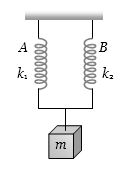
A mass $m$ is suspended by means of two coiled spring which have the same length in unstretched condition as in figure. Their force constant are $k_1$ and $k_2$ respectively. When set into vertical vibrations, the period will be
Specific heats of monoatomic and diatomic gas is same than which relation is valid
A body travels $200\ cm$ in the first two seconds and $220\ cm$ in the next $4$ seconds with same acceleration. The velocity of the body at the end of the $7^{th}$ second is: