MCQ
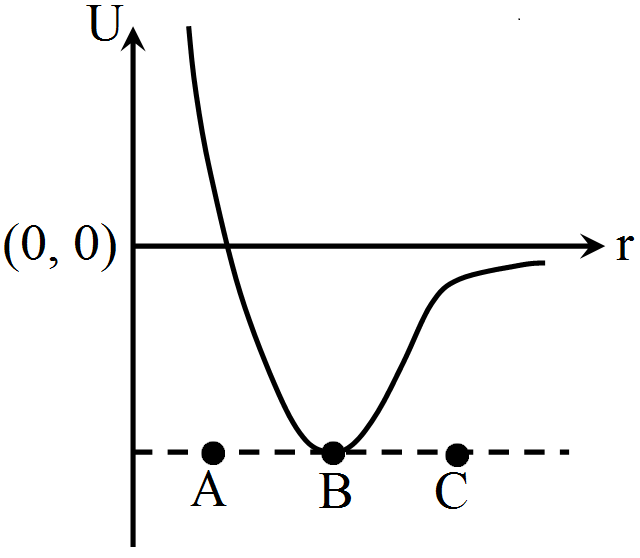
The potential energy U between two molecules as a function of the distance r between them has been shown in the adjoining figure. The two molecules are:
  • A
    Attracted when r lies between A and B and repelled when r lies between B and C.
  • B
    Attracted when r lies between B and C and repelled when r lies between A and B.
  • C
    Attracted when they reach B.
  • D
    Repelled when they reach B.

Answer

  1. Attracted when r lies between B and C and repelled when r lies between A and B.

Need a full question paper?

Generate a complete, print-ready paper with questions like this in minutes — across 16+ boards, with answer keys.

Start Generating Free

Similar questions

A $0.5\, kg$ ball is thrown up with an initial speed $14\, m/s$ and reaches a maximum height of $8.0m. $ How much energy is dissipated by air drag acting on the ball during the ascent .......... $J$
A body moving towards a finite body at rest collides with it. It is possible that:
  1. Both the bodies come to rest.
  2. Both the bodies move after collision.
  3. The moving body comes to rest and the stationary body starts moving.
  4. The stationary body remains stationary, the moving body changes its velocity.
A particle is projected at angle $\theta$ with horizontal from ground. The slop $(m)$ of the trajectory of the particle varies with time $(t)$ as ...........
Which of the following plots represents schematically the dependence of the time period of a pendulum, if measured and plotted as a function of the amplitude of its oscillations? (Note amplitude need not be small)
$P-V$ diagram of a diatomic gas is a straight line passing through origin. The molar heat capacity of the gas in the process will be
A missile is fired for maximum range at your town from a place $100\, km$ away from you. If the missile is first detected at its half way point, how much warning time will you have ? (Take $g = 10\, m/s ^2$) the maximum height of the missile is
Given below are two statements:

Statement $I :$ In a diatomic molecule, the rotational energy at a given temperature obeys Maxwell's distribution.

Statement $II :$ In a diatomic molecule, the rotational energy at a given temperature equals the translational kinetic energy for each molecule.

In the light of the above statements, choose the correct answer from the options given below:

A body is moving with constant speed, in a circle of radius $10 m$. The body completes one revolution in $4 s$. At the end of $3 rd$ second, the displacement of body (in $m$ ) from its starting point is:
An electron with kinetic energy 5eV is incident on a hydrogen atom in its ground state. The collision:
  1. Must be elastic.
  2. May be partially elastic.
  3. Must be completely inelastic.
  4. May be completely inelastic.
When a particle moves in a uniform circular motion. It has