MCQ
The potential gradient is a
  • Vector quantity
  • B
    Scalar quantity
  • C
    Conversion factor
  • D
    Constant

Answer

Correct option: A.
Vector quantity
a
(a)

Potential gradient $=\frac{d V}{d r}=-E$ (Vector)

Need a full question paper?

Generate a complete, print-ready paper with questions like this in minutes — across 16+ boards, with answer keys.
Start Generating Free

Similar questions

Thermopile is used for
Isotopes of same element exists in nature.How they differ from each other?
When the speed of a $dc$ motor increases the armature current
In two separate set - ups of the Young's double slit experiment, fringes of equal width are observed when lights of wavelengths in the ratio 1 : 2 are used. If the ratio of the slit separation in the two cases is 2 : 1, the ratio of the distances between the plane of the slits and the screen in the two set - ups is
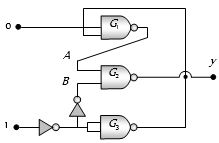
In circuit in following fig. the value of $Y$ is
Light of wavelength $6000\,\mathop A\limits^o$ is incident on a single slit of width $0.3\, mm$. The angular position of first minima will be
Choose the incorrect statement :

$(a)$ The electric lines of force entering into a Gaussian surface provide negative flux.

$(b)$ A charge ' $q$ ' is placed at the centre of a cube. The flux through all the faces will be the same.

$(c)$ In a uniform electric field net flux through a closed Gaussian surface containing no net charge, is zero.

$(d)$ When electric field is parallel to a Gaussian surface, it provides a finite non-zero flux.

Choose the most appropriate answer from the options given below

A charged shell of radius $R$ carries a total charge $Q$. Given $\Phi$ as the flux of electric field through a closed cylindrical surface of height $h$, radius $r$ and with its center same as that of the shell. Here, center of the cylinder is a point on the axis of the cylinder which is equidistant from its top and bottom surfaces. Which of the following option(s) is/are correct ? $\in_0$ is the permittivity of free space]

$(1)$ If $h >2 R$ and $r > R$ then $\Phi=\frac{ Q }{\in_0}$

$(2)$ If $h <\frac{8 R }{5}$ and $r =\frac{3 R }{5}$ then $\Phi=0$

$(3)$ If $h >2 R$ and $r =\frac{4 K }{5}$ then $\Phi=\frac{ Q }{5 \in_0}$

$(4)$ If $h >2 R$ and $r =\frac{3 K }{5}$ then $\Phi=\frac{ Q }{5 \in_0}$

A beam of light is converging towards a point I on a screen. A plane glass plate whose thickness in the direction of the beam = t, refractive index = μ, is introduced in the path of the beam. The convergence point is shifted by
Hydrogen bomb is based on which of the following phenomenon