Question
The principal value of $\tan ^{-1}\left(\tan \frac{9 \pi}{8}\right)$ :

Answer

$\tan ^{-1}\left(\tan \frac{9 \pi}{8}\right)=\tan ^{-1}\left[\tan \left(\pi+\frac{\pi}{8}\right)\right]$
$=\tan ^{-1}\left[\tan \frac{\pi}{8}\right]=\frac{\pi}{8}$
Hence, correct option is $(A)$

Need a full question paper?

Generate a complete, print-ready paper with questions like this in minutes — across 16+ boards, with answer keys.
Start Generating Free

Similar questions

Choose the correct answer from the given four options:
The area of the region bounded by the y-axis, $\text{y}=\cos\text{x}$ and $\text{y}=\sin\text{x},0\leq\text{x}\leq\frac{\pi}{2}$ is:
  1. $\sqrt{2}\text{ sq. units}$
  2. $\big(\sqrt{2}+1)\text{ sq. units}$
  3. $\big(\sqrt{2}-1)\text{ sq. units}$
  4. $\big(2\sqrt{2}-1)\text{ sq. units}$
Linear programming model which involves funds allocation of limited investment is classified as:
  1. Ordination budgeting model
  2. Capital budgeting models
  3. Funds investment models
  4. Funds origin models
Which of the termis not used in a linear programming problem:
  1. Slack inequation
  2. Objective function
  3. Concave region
  4. Feasible Region
The area bounded by the curve $y^{2 }= x,$ line $y = 4$ and $y-$axis is$:$
If the corner points of the feasible region of an LPP are $(0,3),(3,2)$ and $(0,5)$, then the minimum value of $z=11 x+7 y$ is
The general solution of differention eqution $\frac{\text{y}\ \text{dx}-\text{x}\ \text{dy}}{\text{y}}=0$ is:
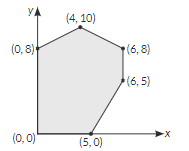
The feasible region for an LPP is shown below: Let $z=3 x-4 y$ be the objective function. Minimum of $z$ occurs at
Image
Choose the correct answer from the given four options:
let $\text{P}(\text{A})=\frac{7}{13},\text{P}(\text{B})=\frac{9}{13}$ and $\text{P}(\text{A}\cup\text{B})=\frac{4}{13}.$ Then $\text{P}\Big(\frac{\text{A'}}{\text{B}}\Big)$ is equal to:
  1. $\frac{6}{13}$
  2. $\frac{4}{13}$
  3. $\frac{4}{9}$ 
  4. $\frac{5}{9}$
If $\text{y}=\frac{\text{ax}+\text{b}}{\text{x}^2+\text{c}},$ then $(2\text{xy}_1+\text{y})\text{y}_3=$
If $\left[\begin{array}{cc}a+b & 2 \\ 5 & a b\end{array}\right]=\left[\begin{array}{ll}6 & 2 \\ 5 & 8\end{array}\right]$, then find the values of $a$ and $b$ respectively.