MCQ
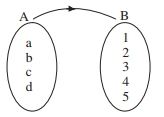
The probability that a randomly chosen one-one function from the set $\{a, b, c, d\}$ to the set $\{1,2,3,4,5\}$ satisfies $f(a)+2 f(b)-f(c)=f(d)$ is
  • A
    $\frac{1}{24}$
  • B
    $\frac{1}{40}$
  • C
    $\frac{1}{30}$
  • $\frac{1}{20}$

Answer

Correct option: D.
$\frac{1}{20}$
d
$n ( s )=5_{ c _{4}} \times 4 !=120$ 

$f ( a )$       + $2 f(b)$        = $f ( c )$       + $f ( d )$
$5$ $2 \times 1$ $4$ $4$
$4$ $2 \times 2$ $3$ $5$
$1$ $2 \times 3$ $2$ $5$

$n ( A )=2 \times 3=6$

$\therefore P ( A )=\frac{ n ( A )}{ n ( s )}=\frac{6}{120}=\frac{1}{20}$
Need a full question paper?

Generate a complete, print-ready paper with questions like this in minutes — across 16+ boards, with answer keys.

Start Generating Free

Similar questions

$\int_{}^{} {{e^{ - x}}{\rm{cose}}{{\rm{c}}^2}(2{e^{ - x}} + 5)} \;dx = $
Let $C_0$ be a circle of radius $I$ . For $n \geq 1$, let $C_n$ be a circle whose area equals the area of a square inscribed in $C_{n-1} .$ Then, $\sum \limits_{i=0}^{\infty}$ Area $\left(C_i\right)$ equals
$\mathop {Limit}\limits_{h\,\, \to \,\,0} \frac{{\int\limits_a^{x\, + \,h} {\,\ell {n^2}t\,\,\,dt} \,\, - \,\,\int\limits_a^x {\,\ell {n^2}t\,\,\,dt} }}{h}$ =
Consider the system of linear equation $x+y+z=$ $4 \mu, x+2 y+2 \lambda z=10 \mu, x+3 y+4 \lambda^2 z=\mu^2+15$, where $\lambda, \mu \in R$. Which one of the following statements is NOT correct?
Statement $1$ : If $A$ and $B$ be two sets having $p$ and $q$ elements respectively, where $q > p$. Then the total number of functions from set $A$ to set $B$ is $q^P$.
Statement $2$ : The total number of selections of $p$ different objects out of $q$ objects is ${}^q{C_p}$.
Let $y=y(x)$ be the solution of the differential equation $\frac{d y}{d x}=2 x(x+y)^3-x(x+y)-1, y(0)=1$. Then, $\left(\frac{1}{\sqrt{2}}+\mathrm{y}\left(\frac{1}{\sqrt{2}}\right)\right)^2$ equals : . . . .  . . .
$\mathop {\lim }\limits_{x \to \infty } \frac{{{{(2x + 1)}^{40}}{{(4x - 1)}^5}}}{{{{(2x + 3)}^{45}}}} = $
Consider a hyperbola $\mathrm{H}$ having centre at the origin and foci and the $\mathrm{x}$-axis. Let $\mathrm{C}_1$ be the circle touching the hyperbola $\mathrm{H}$ and having the centre at the origin. Let $\mathrm{C}_2$ be the circle touching the hyperbola $\mathrm{H}$ at its vertex and having the centre at one of its foci. If areas (in sq. units) of $\mathrm{C}_1$ and $\mathrm{C}_2$ are $36 \pi$ and $4 \pi$, respectively, then the length (in units) of latus rectum of $\mathrm{H}$ is
The number of ways in which $5$ boys and $3$ girls can be seated in a row so that each girl in between two boys
The locus of the middle points of the chords of the parabola ${y^2} = 4ax$ which passes through the origin