MCQ
The product $(B)$ is
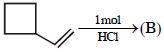
  • A

  • B


  • D

Answer

Correct option: C.

c

Need a full question paper?

Generate a complete, print-ready paper with questions like this in minutes — across 16+ boards, with answer keys.

Start Generating Free

Similar questions

The important mineral$(s)$ of $Al$ is$/$are:
The atomicity of phosphorus is $X$ and the $P\hat PP$ bond angle in the molecule is $Y.$ What are $X$ and $Y$
For micelle formation, which of the following statements are correct?

$(A)$ Micelle formation is an exothermic process.

$(B)$ Micelle formation is an endothermic process.

$(C)$ The entropy change is positive.

$(D)$ The entropy change is negative.

Which position for hydrogen explain all its properties?
The number of nodal planes in a ${p_x}$ is
The dissociation constant of a weak acid is $1.0 \times {10^{ - 5}},$ the equilibrium constant for the reaction with strong base is
What will be $C-H$ bond enthalpy if 

$CH_4(g) +2O_2(g)  \rightarrow  CO_2(g)+2H_2O(l)\,;$  $\Delta H= -890 \,kJ$

$CO_2(g)  \rightarrow  C($graphite$) + O_2(g) \,;$   $\Delta H= 393 \,kJ$

$2H_2O(l)  \rightarrow  2H_2(g) + O_2(g) \,;$  $\Delta H= 571 \,kJ$

$2H_2(g) \rightarrow  4H(g)\, ;$  $\Delta H= 871\, kJ$

$C($graphite$)  \rightarrow  C(g)\, ;$  $\Delta H= 716\, kJ$

For water $\Delta_{\text {vap }} \mathrm{H}=41 \mathrm{~kJ} \mathrm{~mol}^{-1}$ at $373 \mathrm{~K}$ and 1 bar pressure. Assuming that water vapour is an ideal gas that occupies a much larger volume than liquid water, the internal energy change during evaporation of water is $...... \mathrm{kJ}\, \mathrm{mol}^{-1}$

[Use: $\left.\mathrm{R}=8.3 \,\mathrm{~J} \,\mathrm{~mol}^{-1}\, \mathrm{~K}^{-1}\right]$

$\begin{array}{*{20}{c}}
  {C{H_2} - CH_2} \\ 
  {|\,\,\,\,\,\,\,\,\,\,\,\,\,\,\,|\,\,\,\,\,\,} \\ 
  {Cl\,\,\,\,\,\,\,\,\,\,\,Cl\,\,\,\,} 
\end{array}$ $\xrightarrow[{(ii)NaN{H_2}}]{{(i)Alc.KOH}}A\xrightarrow{{\operatorname{Re} d\,hot\,Fe\,tube}}B$ 

Identify product $B$ in above reaction sequence

In a system $A(s)\,\, \rightleftharpoons \,\,2B(g)\,\, + \,3C(g),$  if the concentration of  $C$  at equilibrium is increased by a factor of  $2,$  it will cause the equilibrium concentration of  $B$  to change to