MCQ
The product obtained when acetic acid is treated with phosphorus trichloride is
  • A
    $C{H_3}COOPC{l_3}$
  • B
    $C{H_3}COOCl$
  • $C{H_3}COCl$
  • D
    $ClC{H_2}COOH$

Answer

Correct option: C.
$C{H_3}COCl$
c
(c) $3C{H_3}COOH + PC{l_3} \to {H_3}P{O_3} + 3C{H_3}COCl$

Need a full question paper?

Generate a complete, print-ready paper with questions like this in minutes — across 16+ boards, with answer keys.
Start Generating Free

Similar questions

Amphoteric oxide(s) of $Mn$ is/are
Which of the following statements is not correct?
In order to separate oxygen from one mole of ${H_2}O$ the required quantity of coulomb would be
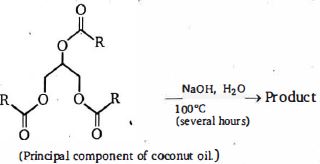
Product is obtained in the above reaction is
Which of the following terms are correct about enzyme?
Molar conductivities $(\Lambda ^o_m)$ at infinite dilution of $NaCl, HCl$ and $CH_3COONa$ are $126.4, 425.9$ and $91.0\, S\, cm^2\, mol^{-1}$ respectively. $(\Lambda ^o_m)$ for $CH_3COOH$ will be .......... $S\, cm^2 \,mol^{-1}$.
The value of 'spin only' magnetic moment for one of the following configuration is  $2.84\, BM.$ The correct one is
Match List $I$ with List $II$.

List I (Complex) List $II$ (Type of isomerism)
$A$. $\left[\mathrm{Co}\left(\mathrm{NH}_3\right)_5\left(\mathrm{NO}_2\right)\right] \mathrm{Cl}_2$ $I$. Solvate isomerism
$B$. $\left[\mathrm{Co}\left(\mathrm{NH}_3\right)_5\left(\mathrm{SO}_4\right)\right] \mathrm{Br}$ $II$. Linkage isomerism
$C$. $\left[\mathrm{Co}\left(\mathrm{NH}_3\right)_6\right]\left[\mathrm{Cr}(\mathrm{CN})_6\right]$ $III$. Ionization isomerism
$D$. $\left[\mathrm{Co}\left(\mathrm{H}_2 \mathrm{O}\right)_6\right] \mathrm{Cl}_3$ $IV$. Coordination isomerism

Choose the correct answer from the options given below:

Two solutions of $X$ and $Y$ electrolytes are taken in two beakers and diluted by adding  $500\, mL$ of water. $\Lambda_m$ of $X$ increases by $1.5$ times while that of $Y$ increases by $20$  times, what could be the electrolytes $X$ and $Y$ ?
Consider the following complex : $[Co(NH_3)_5CO_3]ClO_4$ The coordination  number, oxidation number, no. of $d-$ electrons and number of unpaired $d-$ electrons  on the metal are respectively