MCQ
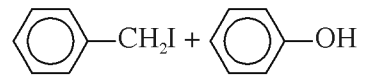
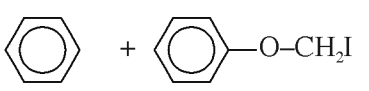
The product of reaction when

Image
  • A

    Image

  • Image
  • C

    Image
  • D
    None of the above

Answer

Correct option: B.

Image
b

Need a full question paper?

Generate a complete, print-ready paper with questions like this in minutes — across 16+ boards, with answer keys.

Start Generating Free

Similar questions

Match complex ion (in List $I$) with number of unpaired electrons (in List $II$)

  List-$I$   List-$II$
$A$ $[Fe(H_2O)_6]^{2+}$ $P$ $0$
$B$ $[Fe(H_2O)_6]^{3+}$ $Q$ $1$
$C$ $[Fe(CN)_6]^{4-}$ $R$ $2$
$D$ $[Fe(CN)_6]^{3-}$ $S$ $4$
$E$ $[Ni(H_2O)_4]^{2+}$ $T$ $5$

$A$   $||$   $B$  $||$   $C$  $||$   $D$   $||$  $E$

In which of the following pairs does the first gas bleaches flowers by reduction while the second gas does so by oxidation
In electrolysis of aqueous copper sulphate, the gas at anode and cathode is
In which case van't Hoff factor is maximum $($assuming no hydrolysis$)\ ?$
Which of the following is a transitional element
Match the column

  Column $-I$   Column $-II$
$(a)$ $[Pt(NH_3)_3Cl]Br$ $(P)$ Coordination
isomerism
$(b)$ $[Cr(NH_3)_5(NCS)]^{+2}$ $(Q)$ Ionisation
isomerism
$(c)$ $[Co(H_2O)_6]Cl_3$ $(R)$ Linkase
isomerism
$(d)$ $[PtCl_4] [Pt(NH_3)_4]$ $(S)$ Hydrated
isomerism


The vacant space in a $\text{bcc}$ unit cell is:
Compound $A$ and $C$ in the following reaction are

$CH_3CHO$ $\xrightarrow[{\left( {ii} \right)\,{H_2}O}]{{(i)\,C{H_3}MgBr}}A\xrightarrow[\Delta ]{{{H_2}S{O_4}}}B\xrightarrow[{Oxidation}]{{Hydroboaration}}C$
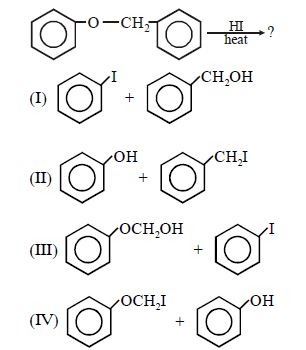
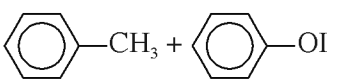
What are the major products from the following reaction?
Given that $\frac{1}{3}\mathop {{\lambda _m}}\limits^\infty  \left( {F{e^{3 + }}} \right) = 68\,oh{m^{ - 1}}\,c{m^{ - 1}}\,e{q^{ - 1}}$ and $\frac{1}{2}\mathop {{\lambda _m}}\limits^\infty  \left( {SO_4^{2 - }} \right) = 80\,oh{m^{ - 1}}\,c{m^{ - 1}}\,e{q^{ - 1}}$ What will be value of $\mathop {{\lambda _{eq}}}\limits^\infty  \left( {F{e_2}{{\left( {S{O_4}} \right)}_3}} \right)$ ? ............ ${\rm{oh}}{{\rm{m}}^{ - 1}}{\mkern 1mu} {\rm{c}}{{\rm{m}}^2}$ $\mathrm{eq}^{-1}$