MCQ
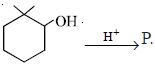
The product $P$ is :
  • A


  • C

  • D

Answer

Correct option: B.

b

Need a full question paper?

Generate a complete, print-ready paper with questions like this in minutes — across 16+ boards, with answer keys.

Start Generating Free

Similar questions

$K _{ a_1,}, K _{ a_2 }$ and $K _{ a_3}$ are the respective ionization constants for the following reactions $(a), (b),$ and $(c)$.

$(a)$ $H _{2} C _{2} O _{4} \rightleftharpoons H ^{+}+ HC _{2} O _{4}^{-}$

$(b)$ $HC _{2} O _{4}^{-} \rightleftharpoons H ^{+}+ HC _{2} O _{4}^{2-}$

$(c)$ $H _{2} C _{2} O _{4} \rightleftharpoons 2 H ^{+}+ C _{2} O _{4}^{2-}$

The relationship between $K_{a_{1}}, K_{ a _{2}}$ and $K_{ a _{3}}$ is given as

As per IUPAC nomenclature, the name of the complex $\left[ Co \left( H _2 O \right)_4\left( NH _3\right)_2\right] Cl _3$ is :
If hydrogen electrode dipped in $2$ solution of $pH = 3$ and $pH = 6$ and salt bridge is connected the e.m.f. of resulting cell is ............ $\mathrm{V}$
Although $CN^-$ ion and $N_2$ molecule are isoelectronic, yet $N_2$ molecule is chemically inert because of
Given :

$E^o_{Fe^{3+} /Fe} = -0.036\,V,$  $E^o _{Fe^{2+} /Fe} = -0.439\,V$

The value of standard electrode potential for the change,

$Fe^{3+} (aq) + e^- \rightarrow Fe^{2+} (aq)$ will be ........ $V$.

What is the absolute configuration of the following molecules ? ($NS =$ the  molecule has no center) Note : For the purpose of this question only, the order of  stereocenters is not specified ; i.e., $R, S = S, R.$

$I$   ||   $II$   ||   $III$   ||   $IV$

Which graph correct correlates $E_{cell}$ as a function of concentrations for the cell (for different values of $M$ and $M'$) :-

$Zn(s) + Cu^{2+}(M) \to Zn^{2+}(M') + Cu(s);$    $E^o _{cell} = 1.10\,V$

$X$-axis :$log_{10}$ $\frac{{[Z{n^{2 + }}]}}{{[C{u^{2 + }}]}}$,  $Y$ -axis : $E_{cell}$

Half life of a reaction is found to be inversely proportional to the cube of its initial concentration. The order of reaction is
The freezing point of equimolal aqueous solution will be highest for
Which solution of $NaNO_3$ will have maximum specific conductance ............ $\mathrm{N}$