MCQ
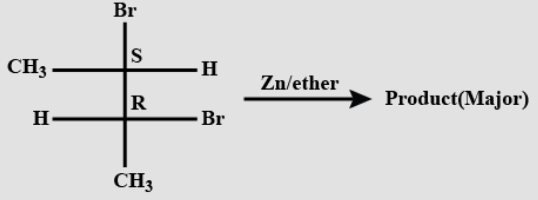
The product will be :
  • A
    Cis $- 2 -$ butene
  • Trans $- 2 - $ butene
  • C
    $2 -$ butyne
  • D
    Buta $- 1 , 3 -$ diene

Answer

Correct option: B.
Trans $- 2 - $ butene
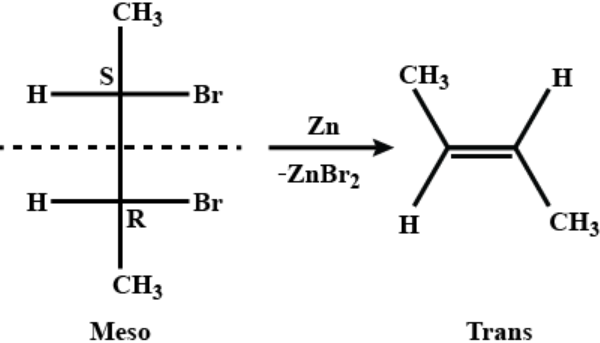
Since elimination is trans $-$ in nature so meso $-$ compound will give generally trans $-$ alkene as major.

Need a full question paper?

Generate a complete, print-ready paper with questions like this in minutes — across 16+ boards, with answer keys.

Start Generating Free

Similar questions

Which one of the following arrangements represents the correct order of electron gain enthalpy (with negative sign) of the given atomic species
$0.3\,g$ of ethane undergoes combustion at $27^{\circ}\,C$ in a bomb calorimeter. The temperature of calorimeter system (including the water) is found to rise by $0.5^{\circ}\,C$. The heat evolved during combustion of ethane at constant pressure is $.......kJ\,mol { }^{-1}$.

(Nearest integer)

[Given : The heat capacity of the calorimeter system is $20\, kJ\, K ^{-1}, R =8.3\, JK ^{-1}\, mol ^{-1}$.

Assume ideal gas behaviour.

Atomic mass of $C$ and $H$ are $12$ and $1\, g\, mol ^{-1}$ respectively]

The unit $J \,P{a^{ - 1}}$ is equivalent to
Copper wire test for halogens is known as
For the following two acid-base reactions, which statement is True ?

$(I){\mkern 1mu} C{H_3}CH_2^ - {\mkern 1mu}  + {\mkern 1mu} \mathop {C{H_3}N{H_2}}\limits_{p{K_a} = 35}  \rightleftharpoons \mathop {C{H_3}C{H_3}}\limits_{p{K_a} = 50}  + C{H_3}N{H^ - }$

$(II){\mkern 1mu} {F^ - }{\mkern 1mu}  + {\mkern 1mu} \mathop {{H_2}O}\limits_{p{K_a} = 15.7}  \rightleftharpoons \mathop {HF}\limits_{p{K_a} = 3.2}  + H{O^ - }$

If an endothermic reaction is non-spontaneous at freezing point of water and becomes feasible at its boiling point, then
The first ionisation potential is maximum for :
Ethylene reacts with ozone to give
The reaction of propene with $HOCl$ proceeds via the addition of
By knowing the number of protons in a neutral atom, one can determine :