Question
The property which differentiates two kinds of charges is called ____________?

Answer

  1. Polarity of charge
Explanation:
The property which differentiates two kinds of charges is called polarity of charge.

Need a full question paper?

Generate a complete, print-ready paper with questions like this in minutes — across 16+ boards, with answer keys.
Start Generating Free

Similar questions

The maximum intensity of fringes in Young's experiment is $I.$ If one of the slit is closed, then the intensity at that place becomes $I_o.$ Which of the following relation is true ?
Kinetic energy of emitted cathode rays is dependent on(a) Only voltage(b) Only work function(c) Both (a) and (b)(d) It does not depend upon any physical quantity


If three capacitors each of capacity 1μF are connected in such a way that the resultant capacity is 1.5 μF,  then(a) All the three are connected in series(b) All the three are connected in parallel(b) All the three are connected in parallel(d) Two of them are in series and then connected in parallel to the third


Sodium has body centred packing. If the distance between two nearest atoms is 3.7 Å, then its lattice parameter is (a) 4.8 Å (b) 4.3 Å(c) 3.9 Å  (d) 3.3 Å
       
The specific charge of an electron is
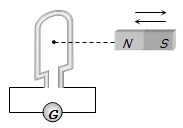
When a magnet is pushed in and out of a circular coil $C$ connected to a very sensitive galvanometer $G$ as shown in the adjoining diagram with a frequency $v,$ then
L, C and R represent the physical quantities inductance, capacitance and resistance respectively. Which of the following combinations have dimensions of frequency?
  1. $\frac{1}{\text{RC}}$
  2. $\frac{\text{R}}{\text{L}}$
  3. $\frac{1}{\sqrt{\text{LC}}}$
  4. $\text{C}/\text{L}$
A wire of length $100 \ cm$ is connected to a cell of emf $2\ V$ and negligible internal resistance.  The resistance of the wire is $3\Omega$.  The additional resistance required to produce a potential drop of $1$ milli volt per cm is
Dimensions of mutual inductance is :
An eye specialist prescribes spectacles having a combination of convex lens of focal length 40 cm in contact with a concave lens of focal length 25 cm. The power of this lens combination in diopters is(a) + 1.5(b) – 1.5(c) + 6.67(d) – 6.67